Federal prosecutors in Manhattan charged the founder of non-fungible token (NFT) startup Few and Far with securities fraud and wire fraud.
The prosecutors alleged that Taj Tarsha diverted more than $10 million raised from investors into online gambling, cryptocurrency speculation and personal expenses instead of building the company’s marketplace.
The 34-year-old raised the funds from at least 67 investors beginning in February 2022 through Simple Agreements for Future Tokens (SAFTs), the U.S. Attorney’s Office for the Southern District of New York said in a statement.
SAFTs give a project’s financial backers the right to receive tokens once they are available. Few and Far’s investors had the right to receive 95 million FAR tokens while funding development of the company’s planned decentralized NFT marketplace.
The prosecutors allege Tarsha began misappropriating investor funds almost immediately after the fundraising closed.
The alleged misconduct was uncovered in a June 2023 audit, according to the statement. Prosecutors claim Tarsha falsely told investors that bonuses he received were tied to token presale milestones and that company funds were being used to advance the project.
Solana has kicked off August by proving why it’s one of the most efficient L1.
On the fundamentals side, two major network upgrades are gaining momentum. The first is the deflationary upgrade, which has officially entered its final voting stage.
Meanwhile, SIMD-0525 is now live on testnet, cutting slot time from 400 ms to 350 ms as the first step toward a 200 ms slot time. Together, these developments point to a faster network, reinforcing Solana’s scalability thesis heading into Q4.
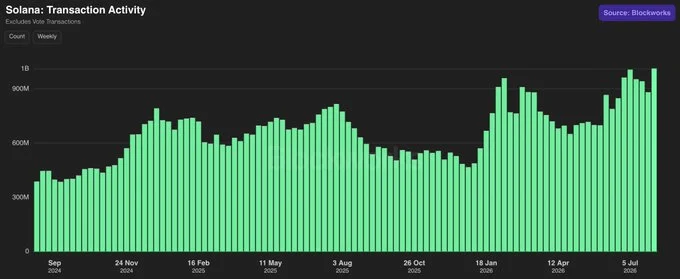
The key takeaway? The impact is already showing up on-chain. As the chart below highlights, Solana’s weekly transaction count crossed the 1 billion mark for the first time, reaching a record 1,012,226,009 transactions from the 27th of July to the 2nd of August.
Source: Blockworks
In essence, Solana’s network upgrades aren’t just improving performance on paper.
Instead, they’re supporting record transaction throughput as on-chain activity continues to scale. From a fundamentals standpoint, that’s a strong signal.
Sustained transaction growth reinforces Solana’s core strengths, such as high TPS, low-latency finality, and the network’s ability to process more activity.
However, while the 1 billion weekly transaction milestone clearly validates Solana’s scalability, another key on-chain signal appears to be emerging.
If it continues to build, it could give Solana [SOL] an additional edge as the market heads toward Q4.
Tokenized gold pushes Solana to a new network milestone
The market is already calling August a “huge month” for Solana.
Interestingly, that narrative isn’t being driven by SOL’s price action. The token is up just over 1.8% so far this month, lagging Cardano’s 11% gain over the same period.
Instead, the focus has shifted to Solana’s fundamentals, with network upgrades driving the bullish narrative rather than short-term price speculation.
Notably, this is where the chart below becomes important. While the 1 billion transaction milestone confirms Solana’s growing network activity, another signal is starting to stand out.
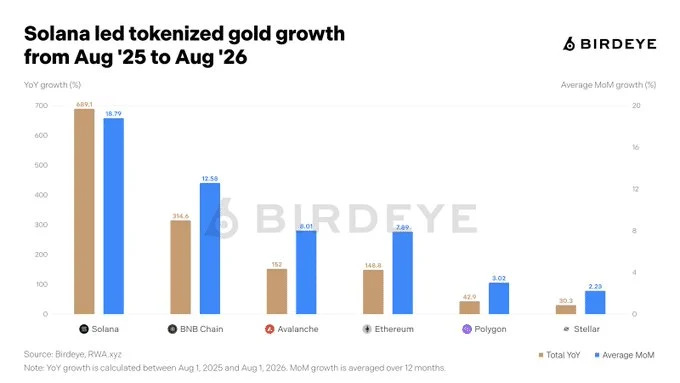
Over the past year, Solana has led all major L1s in the growth of tokenized gold, one of the fastest-growing segments within the RWA market.
Source: BirdEye
To put into context, since August 2025, Solana’s tokenized gold market cap has grown 689.1%, averaging 18.8% month-over-month growth.
That’s more than 2x the year-over-year growth recorded by BNB Chain and roughly 4.6x the growth seen on Avalanche and Ethereum.
The timing couldn’t be better. From a macro perspective, gold is regaining momentum, with spot prices climbing above $4,200/oz to their highest level since June 2022.
If the rally extends, it could drive fresh demand for tokenized gold, an area where Solana already holds a clear growth advantage.
That, in turn, could further strengthen the on-chain activity and provide another fundamental tailwind for SOL heading into Q4.
Final Summary
Solana hit a record 1 billion weekly transactions, showing its network upgrades are already driving stronger on-chain activity.
Solana also leads the tokenized gold market. With gold prices rising again, that could give SOL another boost heading into Q4.
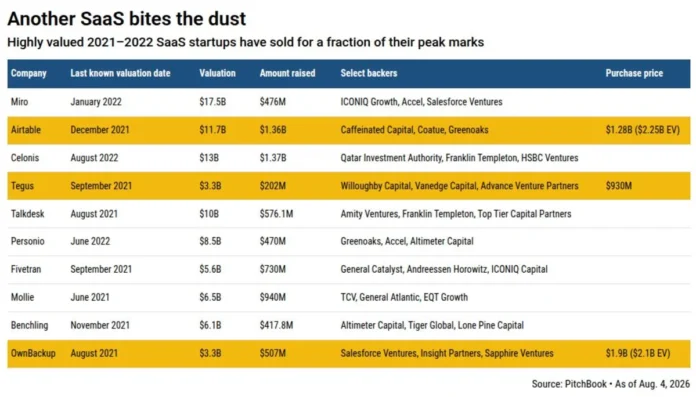
The newly public Italian tech conglomerate Bending Spoons has scooped up another company, database startup Airtable, for $1.28 billion in cash at an equity value of $2.25 billion. It’s a roughly 80% discount for the Thrive- and Coatue-backed company that was valued at $11.7 billion in 2021.
The acquisition underscores calamitous exit prospects for a cohort of SaaS companies that were once pitched as tomorrow’s tech giants.
“Airtable is a negative for private-market marks and positive for liquidity,” said PitchBook senior analyst Derek Hernandez, who has written about AI’s effect on SaaS businesses. “The exit market has been stalled for the last few years, driven by the chasm between 2021 valuations and the cash flows a new buyer could underwrite. A reset of roughly 80% represents at least one instance of the gap closing.”
Airtable raised a $735 million Series F in 2021 at an $11.7 billion valuation led by XN with participation from Silver Lake, Salesforce Ventures, Benchmark and others. The startup raised $1.36 billion in total from private investors, according to PitchBook data.
Other SaaS companies that last raised in 2021 and 2022 haven’t fared much better in their exit prospects. Tegus, a fintech research and corporate intelligence platform startup, was valued at $3.3 billion in 2021 before being acquired by AlphaSense for $930 million in June 2024, a roughly 72% discount off its previous valuation.
Companies in Airtable’s cohort—SaaS startups that last raised during the VC high times of 2021 and 2022—face bleak prospects given the pressure that AI has put on software valuations.
Talkdesk, a startup developing contact-center management software, last raised a $230 million Series D in August 2021, which tripled its valuation from $3 billion to $10 billion. Miro, a collaborative workspace software startup, raised $400 million in Series C funding in January 2022. Its valuation was $17.5 billion.
Many of these startups have rebranded their offerings as AI. But Airtable, whose CEO claims to be building “the AI-native platform of the future,” demonstrates that commanding top dollar is more than just a marketing exercise.
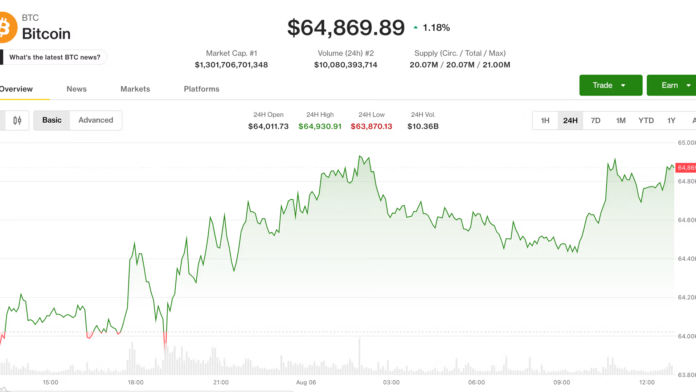
Bitcoin hovered near $64,830 on Thursday, up 0.8% over 24 hours and 1.3% on the week, while trading inside a narrow band, CoinDesk data show. Ether rose 2.1%, but most other majors barely moved, leaving the market less in rally mode than in wait-and-see mode.
The bid under bitcoin is coming from macro hopes rather than fresh crypto demand. President Donald Trump pointed to strong employment, better manufacturing data and cooling inflation, while also raising the possibility of a deal to reopen the Strait of Hormuz.
A reopening would likely pressure oil lower, easing inflation worries and giving Treasury yields and the dollar room to fall. That is the setup risk assets want, and bitcoin is trading like some of it may arrive.
The problem is that the trade still depends on several steps lining up. Lower oil has to feed into lower inflation expectations. Lower inflation expectations have to pull down real yields and the dollar.
Its roughly 63% correlation with the S&P 500 also means equity sentiment may matter more than crypto-native flows in the near term. A calmer Middle East backdrop helps risk appetite, but it can also reduce the safe-haven demand that supported bitcoin earlier in the summer.
The levels to watch are real yields and the dollar. If both fall alongside oil, bitcoin has a cleaner path above the top of its recent range. If yields stay firm, the macro case remains theoretical and bitcoin likely stays pinned near $65,000.
American flag on NY Stock Exchange by Chameleonseye via iStock
The S&P 500 Index ($SPX) (SPY) on Tuesday closed up +1.79%, the Dow Jones Industrial Average ($DOWI) (DIA) closed up +1.71%, and the Nasdaq 100 Index ($IUXX) (QQQ) closed up +3.32%. September E-mini S&P futures (ESU26) rose +1.79%, and September E-mini Nasdaq futures (NQU26) rose +3.22%.
Stock indices rallied sharply on Tuesday, with the S&P 500 and Dow Jones Industrials posting new all-time highs and the Nasdaq 100 posting a 3-week high. Strength in technology stocks led the broader market higher on some better-than-expected earnings results. Palantir Technologies rose more than +29% after reporting stronger-than-expected Q2 revenue and raising its full-year revenue forecast. Also, Zebra Technologies rose more than +28% after reporting better-than-expected Q2 EPS and raising its full-year EPS forecast. In addition, Caterpillar rose more than +5% after reporting Q2 adjusted EPS that was well above the consensus.
More News from Barchart
Market sentiment also improved on Tuesday after a plunge in crude oil prices eased inflation fears and pushed bond yields lower. Crude prices gave up an overnight advance and sold off as the prospect of a deal between the US and Iran to reopen the Strait of Hormuz appears to be gaining traction, with US and Iranian officials sounding hopeful about an agreement to reopen the waterway. The 10-year T-note yield fell -6 bp to 4.62%.
On the negative side for stocks was Tuesday’s US economic news that was weaker than expected. June factory orders unexpectedly fell -0.3% m/m, weaker than expectations of +0.2% m/m. Also, June factory orders ex-transportation unexpectedly fell -0.4% m/m versus expectations of +0.4% m/m and the biggest decline in 14 months. In addition, June JOLTS job openings fell -178,000 to 7.359 million, showing a weaker labor market than expectations of 7.454 million.
The US June trade deficit was -$73.3 billion, slightly larger than expectations of -$73.0 billion and a negative factor for Q2 GDP.
Sep WTI crude oil prices (CLU26) tumbled more than -5% on Tuesday to a 3-week low after a Qatari spokesman said a proposed resolution “is being circulated between the US and Iran,” cautioning that a deal has not yet been reached. Crude prices extended their losses on Tuesday when Treasury Secretary Bessent said: “There is a chance we may have a deal today or tomorrow to open the strait.” Also, the key Saudi export port of Yanbu in the Red Sea had its busiest day on Monday since Houthi rebels began attacking shipping in the region, as more ships transited through the Bab el-Mandeb chokepoint.
President Trump has threatened Iran with renewed air strikes and stressed that his latest offer of talks is Iran’s “last chance” as he demanded full reopening of the Strait of Hormuz. A diplomatic resolution is hanging on talks between Oman and Iran to get more ships moving through the strait, but Iran continues to insist on its authority over the waterway.
The outlook for strong Q2 earnings is a bullish factor for stocks. Forecasts compiled by Bloomberg Intelligence suggest Q2 earnings may increase by +23%, close to Q1’s blowout earnings of +30%, which was more than double the +12% analysts had expected. AI spending is expected to account for most of earnings, with AI infrastructure stocks set to contribute nearly 60% of the S&P 500’s earnings-per-share growth in Q2. So far, earnings results have been positive, with 86% of the 322 S&P 500 companies that have reported Q2 earnings beating estimates, according to Bloomberg data.
The markets are discounting a 58% chance of a +25 bp rate hike at the next FOMC meeting on September 15-16.
Overseas stock markets settled higher on Tuesday. The Euro Stoxx 50 rose to a new all-time high and closed up +0.94%. China’s Shanghai Composite closed up +0.33%. Japan’s Nikkei-225 Stock Average closed up +0.32%.
Interest Rates
September 10-year T-notes (ZNU6) on Tuesday closed up +13.5 ticks. The 10-year T-note yield fell -5.5 bp to 4.621%. T-notes recovered from overnight losses and pushed higher on Tuesday after crude oil prices fell sharply. WTI crude oil sank more than -5% on Tuesday to a 3-week low, lowering inflation expectations. T-notes added to their gains on Tuesday amid weaker-than-expected US economic reports, including June JOLTS job openings and June factory orders. Tuesday’s rally in the S&P 500 to a new record high limited the upside in T-notes.
European government bond yields moved lower on Tuesday. The 10-year German bund yield dropped to a 3-week low of 3.102% and finished down -4.5 bp to 3.107%. The 10-year UK gilt yield fell to a 3-week low of 4.892% and finished down -5.6 bp to 4.897%.
Markets are discounting a 79% chance of a +25 bp ECB rate hike at its next policy meeting on September 10.
US Stock Movers
Chipmakers and AI-infrastructure stocks rallied sharply on Tuesday, boosting the overall market. The Philadelphia Stock Exchange Semiconductor Index ($SOX) climbed to a 1-week high and closed up more than +6%. ARM Holdings (ARM) closed up more than +17%, and Marvel Technology (MRVL) closed up more than +12%. Also, Sandisk (SNDK) and Intel (INTC) closed up more than +10%, and Micron Technology (MU), Advanced Micro Devices (AMD), Microchip Technology (MCHP), Lam Research (LRCX), and Qualcomm (QCOM) closed up more than +7%. In addition, KLA Corp (KLAC) and Broadcom (AVGO) closed up more than +6%, and Applied Materials (AMAT), NXP Semiconductors NV (NXPI), Analog Devices (ADI), and Texas Instruments (TXN) closed up more than +5%.
Cybersecurity stocks rallied on Tuesday. Cloudflare (NET) closed up more than +7%, and Palo Alto Networks (PANW) and Zscaler (ZS) closed up more than +5%. Also, CrowdStrike Holdings (CRWD) and Okta (OKTA) closed up more than +4%, and Fortinet (FTNT) closed up more than +3%.
Airlines and cruise line operators moved higher on Tuesday amid sinking crude oil prices. Alaska Air Group (ALK) closed up more than +4%, and American Airlines Group (AAL), United Airlines Holdings (UAL), Southwest Airlines (LUV), and Carnival (CCL) closed up more than +3%. Also, Delta Air Lines (DAL), Royal Caribbean Cruises (RCL), and Norwegian Cruise Line Holdings (NCLH) closed up more than +1%.
Energy stocks and service providers were under pressure on Tuesday after WTI crude oil fell more than -5% to a 3-week low. Diamondback Energy (FANG) closed down more than -3% to lead losers in the Nasdaq 100, and APA Corp (APA) closed down more than -3%. Also, Chevron (CVX), ExxonMobil Holdings (XOM), ConocoPhillips (COP), and Devon Energy (DVN) closed down more than -1%.
Palantir Technologies (PLTR) closed up more than +29% to lead gainers in the S&P 500 and Nasdaq 100 after reporting Q2 revenue of $1.94 billion, better than the consensus of $1.81 billion, and raising its full-year revenue estimate to $8.15 to $8.16 billion from a previous estimate of $7.65 billion to $7.66 billion.
Zebra Technologies (ZBRA) closed up more than +26% after reporting Q2 adjusted EPS of $6.35, well above the consensus of $4.37, and raising its full-year adjusted EPS estimate to $20.75 to $21.25 from a previous forecast of $$18.30 to $18.70.
Ameresco (AMRC) closed up more than +23% after raising its full-year adjusted EPS forecast to $1.15 to $1.35 from a previous estimate of $1.06 to $1.28, stronger than the consensus of $1.10.
Gartner (IT) closed up more than +22% after raising its full-year adjusted Ebitda forecast to $1.57 billion from a previous forecast of $1.52 billion, above the consensus of $1.56 billion.
Broadridge Financial Solutions (BR) closed up more than +7% after reporting Q4 revenue of $2.22 billion, stronger than the consensus of $2.17 billion.
Caterpillar (CAT) closed up more than +5% to lead gainers in the Dow Jones Industrials after reporting Q2 adjusted EPS of $8.17, well above the consensus of $6.17.
Bruker Corp. (BRKR) closed down more than -21% after reporting Q2 revenue of $838.5 million, weaker than the consensus of $853.6 million.
Aptiv Plc (APTV) closed down more than -16% to lead losers in the S&P 500 after reporting Q2 net sales of $3.30 billion, weaker than the consensus of $3.32 billion, and cutting its full-year net sales forecast to $12.60 billion to $12.80 billion from a previous forecast of $12.80 billion to $13.20 billion.
NRG Energy (NRG) closed down more than -15% after saying that lower load and power prices in Texas, as well as higher power supply costs, are weighing on its full-year earnings.
Chipotle Mexican Grill (CMG) closed down more than -9% after removing jalapeños from multiple stores in Minnesota after learning the peppers may be linked to a salmonella outbreak in the state that’s sickened 110 people.
Nike (NKE) closed down more than -2% to lead losers in the Dow Jones industrials after JPMorgan Chase downgraded the stock to underweight from neutral with a price target of $40.
Earnings Reports (8/5/2026)
Albemarle Corp (ALB), Allstate Corp/The (ALL), APA Corp (APA), AppLovin Corp (APP), Atmos Energy Corp (ATO), Axon Enterprise Inc (AXON), Block Inc (XYZ), CDW Corp/DE (CDW), Cencora Inc (COR), CF Industries Holdings Inc (CF), Charles River Laboratories International (CRL), Corpay Inc (CPAY), CVS Health Corp (CVS), DoorDash Inc (DASH), eBay Inc (EBAY), Eli Lilly & Co (LLY), Expedia Group Inc (EXPE), Global Payments Inc (GPN), Honeywell Aerospace Inc (HONA), Host Hotels & Resorts Inc (HST), Insulet Corp (PODD), Iron Mountain Inc (IRM), Kraft Heinz Co/The (KHC), McKesson Corp (MCK), MetLife Inc (MET), Motorola Solutions Inc (MSI), News Corp (NWSA), NiSource Inc (NI), Occidental Petroleum Corp (OXY), Phillips 66 (PSX), Realty Income Corp (O), Sandisk Corp (SNDK), Solventum Corp (SOLV), STERIS PLC (STE), Texas Pacific Land Corp (TPL), Uber Technologies Inc (UBER), Walt Disney Co/The (DIS), Western Digital Corp (WDC), Zimmer Biomet Holdings Inc (ZBH).
On the date of publication, Rich Asplund did not have (either directly or indirectly) positions in any of the securities mentioned in this article. All information and data in this article is solely for informational purposes. This article was originally published on Barchart.com
At SpaceX’s market debut on June 12, the perfect trade already looked obvious. Shares priced at $135, valuing the company at roughly $1.8 trillion, and closed near $161, pushing its market capitalization above $2.1 trillion. Four days later they reached $225.64, and for one brief week the chart resembled the trajectory of one of the company’s own rockets.
Then gravity returned.
Seven weeks later, SpaceX trades below $110, far below its IPO price. More than $1 trillion of market value has evaporated from the peak. Most employees could do nothing but watch because their pre-IPO shares remained locked up.
In hindsight, the right trade is obvious. In real time, it never is.
What makes SpaceX different isn’t simply the size of the IPO. It is the scale of wealth it transferred into the hands of employees. Few public offerings have created so many paper millionaires so quickly. A position worth $50 million may look life-changing, but it is still only paper wealth. Before a single share can be sold, market volatility, taxes and trading restrictions will determine how much of that fortune actually survives.
Unlike a traditional IPO, there is no single day when employees suddenly become liquid. SpaceX replaced the familiar 180-day cliff with staggered release dates that resemble stage separation. Portions of employee holdings become eligible after second-quarter earnings, additional tranches follow throughout the fall, the principal lockup expires in December, while other holdings, including Elon Musk’s, remain restricted until June 2027. Even after shares become eligible for sale, trading windows, blackout periods and securities-law restrictions may continue to delay transactions.
The calendar, not the stock price, has become the scarce resource.
The debate naturally centers on whether employees should sell or hold. Yet history suggests neither answer is universally correct.
Netflix created one of Silicon Valley’s greatest fortunes for employees who ignored conventional advice and remained heavily concentrated. Diversification would have reduced risk, but it also would have dramatically reduced wealth. The lesson is not that diversification is wrong. It is that the best financial outcome and the best financial decision are rarely the same thing.
The more interesting question is what can be accomplished before the first shares are sold.
Ironically, a declining stock price often improves the most valuable planning opportunities. The federal estate and gift tax exemption now stands at $15 million per person. Transferring shares to heirs or irrevocable trusts after a decline consumes less of that exemption while allowing future appreciation to occur outside the taxable estate. Volatility also improves the economics of techniques such as grantor retained annuity trusts, which are specifically designed to transfer future appreciation with minimal gift-tax cost.
Employees holding incentive stock options face a similar opportunity. Because alternative minimum tax exposure is driven largely by the spread between exercise price and fair market value, lower prices can substantially reduce the tax cost of beginning the long-term holding period.
Timing matters elsewhere as well. Equity compensation frequently produces a gap between tax withholding and actual tax liability, particularly for highly compensated employees in California. A December sale and a January sale may be separated by only days, yet fall into different tax years, creating flexibility to manage income recognition, estimated tax payments and cash flow.
The earliest employees should investigate one additional question before selling anything: whether their shares qualify for the federal Qualified Small Business Stock exclusion. For stock issued during SpaceX’s earliest years, when the company was still a startup, the benefit could shelter millions of dollars of capital gain. Once shares are sold, the opportunity is gone.
The same principle applies to charitable planning. Appreciated stock donated directly to charity or a donor-advised fund generally avoids capital gains tax on the embedded appreciation. Selling first and donating cash does not.
California adds another layer of complexity. Many employees assume moving out of state before selling automatically eliminates California tax. It often does not. The compensation element of equity awards generally remains taxable to California based on where the services were performed, even if the employee later establishes residency elsewhere. Understanding where compensation ends and investment appreciation begins can be worth millions.
None of this answers the question every employee is asking: Where does SpaceX stock go next?
No adviser can answer that.
The better question is one only the employee can answer: If this entire fortune were already sitting in cash today, how much would you invest in SpaceX?
Everything else, the lockups, the tax elections, the trusts, the charitable gifts, is simply a framework for acting on that answer.
SpaceX taught its employees to think in terms of launch windows. Their financial planning now requires the same discipline. The goal is not simply to become a millionaire on IPO day. It is to remain one long after the headlines have faded.
The opinions expressed in Fortune.com commentary pieces are solely the views of their authors and do not necessarily reflect the opinions and beliefs of Fortune.
Circle Internet Group (NYSE: CRCL) saw its shares jump by 5% during pre-market hours on Wednesday, 5th August. The stock of the USDC stablecoin issuer surged following strong profits beyond analysts’ forecasts, despite falling short on revenue targets.
The issuer reported 7% annual revenue growth of $701M, but this slightly fell short of analysts’ expectations of $713M. However, it posted adjusted earnings of 18 cents, surpassing analysts’ forecast of 16 cents.
In particular, the firm’s US dollar-backed stablecoin, USDC, saw strong growth. The stablecoin ended Q2 at $73.3B in supply, marking a 19% growth year-over-year (YoY) while USDC on-chain transfer volume increased by 150% to $14.8 trillion.
Commenting on the results, Circle CEO Jeremy Allaire said,
Our quarterly financial results reflect the current rate environment and a crypto market that has slowed – both are conditions outside our network. But near-term activity tells a different story.
Circle’s bet on Arc blockchain and tokenization
The report also shed light on the firm’s Arc blockchain. Circle said that over 100 institutions and firms, including BlackRock, BNY Mellon, DTCC and Standard Chartered, have been building on the chain designed for tokenized assets, payments, and an agentic economy.
The chain is expected to debut publicly on 16th September.
Besides, the firm scored some wins on the licenses front; a federal one from OCC to operate a national trust bank and a state-level one from New York.
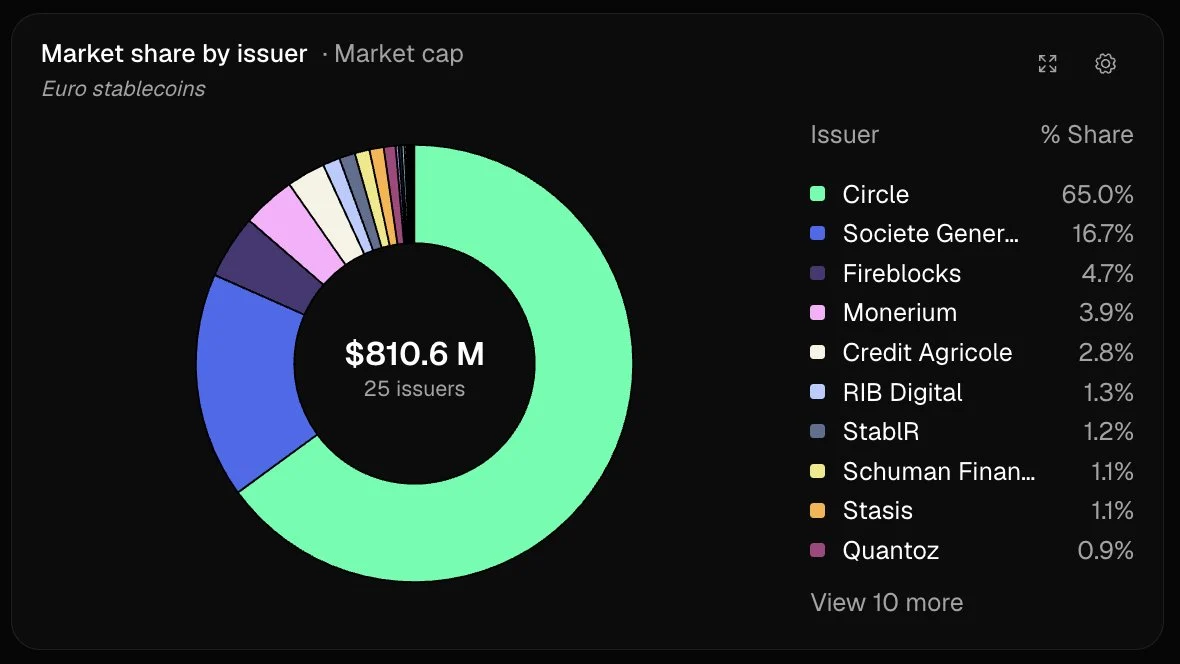
Another positive note that was not captured by the report was its growing moat in Euro-based stablecoins. According to Token Terminal data, the issuer now controls 65% of the Euro-pegged stablecoin market, thanks to its EURC product.
Only Paris-based Société Générale came in second at 16% market share.
Source: Token Terminal
In terms of supply growth, however, the EURC only increased by 0.11% YoY and had a $455.8M market cap. Most of the supply was concentrated on Ethereum, Solana, and Base.
The increasing moat in the Eurozone was partly due to Tether bowing out of the market. Tether decided not to apply for a MiCA license, claiming that the rules were risky and designed to protect the upcoming digital Euro.
Analysts go bullish on Circle stock
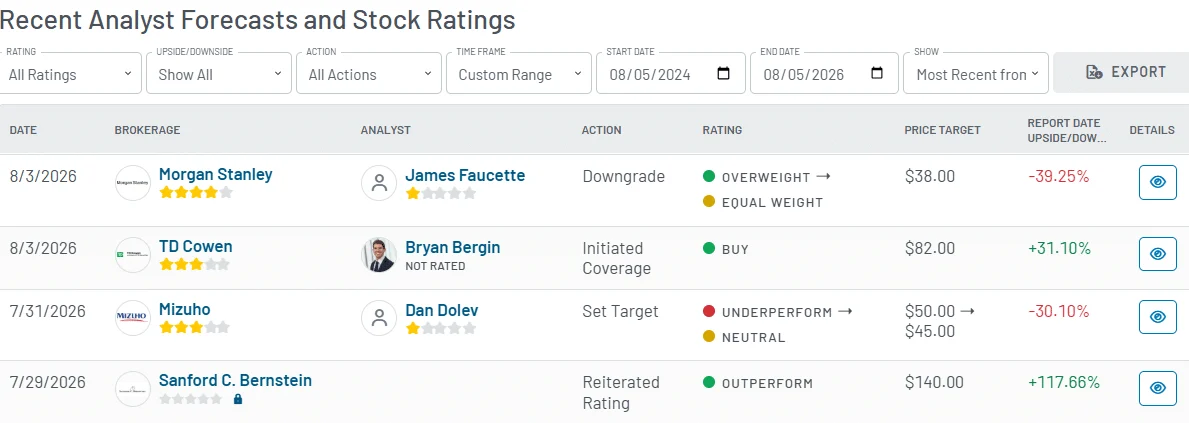
Here, it’s worth pointing out that Morgan Stanley downgraded the CRCL stock with a bearish price target of $38, implying a 39% downside from the current $63.5. According to the wirehouse, slow USDC supply growth and competition in tokenized money market funds could affect Circle’s revenue.
Even so, the analysts’ consensus target was $104, hinting at a 64% upside potential. In fact, Bernstein projected that CRCL stock could rally as high as $140.
Source: Market Beat
Final Summary
Circle posted $701M in revenue in Q2 2026, slightly missing analysts’ target of $713M.
Despite Morgan Stanley’s bearish call, analysts’ consensus projected a 64% upside potential.