Home Blog Page 130

Warren Buffett’s Berkshire Could Buy Almost Any S&P 500 Company With Its $397 Billion Cash Pile, but Keeps Waiting for a Better Price

0
Warren Buffett's Berkshire Could Buy Almost Any S&P 500 Company With Its $397 Billion Cash Pile, but Keeps Waiting for a Better Price


You know the expression “burning a hole in my pocket?” It’s an old phrase for the restless feeling some people get when they have extra cash. But spending money on a whim is no way to invest, and it could lead to bad habits that get you in trouble one day.

I think this is a problem Warren Buffett never had. Buffett led Berkshire Hathaway (NYSE: BRKA) (NYSE: BRKB) for six decades before turning the reins over to Greg Abel, its new CEO, at the beginning of the year. And during his tenure, Buffett built an impressive conglomerate that also holds an exceptionally large cash position.

Missed Nvidia in 2009? This Rare Signal Is Flashing Again. In 2009, a “Double Down” signal flashed for a little-known chipmaker called Nvidia. For the first time in years, that same “Total Conviction” signal is flashing for a company 1/100th the size of Nvidia. Continue »

How large? At the end of the first quarter, Berkshire’s cash was a whopping $397.4 billion. Put another way, there are only two dozen companies in the entire S&P 500 with a market capitalization that’s greater than Berkshire Hathaway’s cash pile.

What are Buffett (who’s now Berkshire’s chairman of the board) and Abel waiting for?

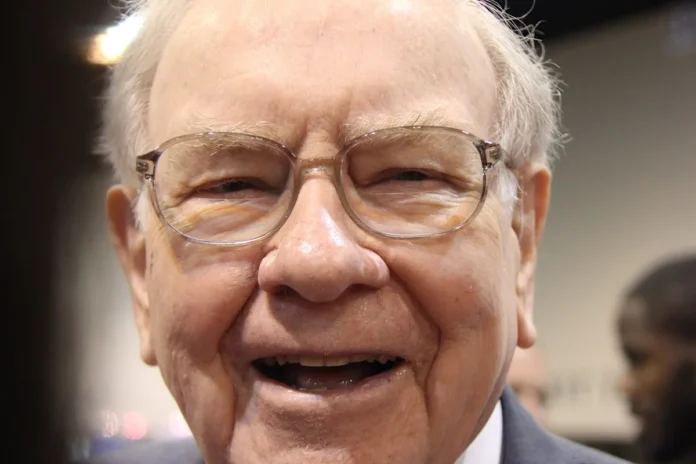
Berkshire Hathaway chairman of the board, Warren Buffett. Image source: The Motley Fool.

Berkshire’s management wants to spend

In an interview with CNBC earlier this year, Buffett said he would rather have the company’s money working rather than sitting in an account or in Treasury bills. “It’s external circumstances,” he said. “Believe me, if after we get finished talking, you say, ‘I’ve got a great $100 billion new idea.’ I would say, ‘Let’s talk.'”

In a February letter to shareholders, Abel also addressed Berkshire’s cash hoard. “Many times in Berkshire’s history, some observers have suggested that our substantial cash position signals a retreat from investing. It does not,” he wrote. “We continue to evaluate many opportunities and will remain patient and disciplined in pursuing the right ones for the benefit of our owners.”

Stocks are too expensive for Buffett’s taste

The challenge facing Berkshire Hathaway — and investors in general — is that stocks today are historically expensive.

One such indicator is the Buffett indicator, named for Warren Buffett himself. This indicator measures the total value of the U.S. stock market and divides it by gross domestic product (GDP). The result is a measurement of the stock market’s size compared to the nation’s overall economic output — a number Buffett has referred to as “probably the best single measure of where valuations stand at any given moment.”


The current ratio stands at 219% — about 64% above the historical trend. To put the number into perspective, Buffett has said any number over 200% means that the market is “playing with fire.”

Does that mean that investors should forsake the market entirely right now? Of course not. Buffett and Abel are still putting Berkshire’s money to work in Treasuries, but they’ve not backed out of the market at all. Berkshire’s current investment portfolio is valued at $361 billion, and the company under Abel has both sold and bought stock, including opening new positions in Delta Air Lines and Macy’s.

Until valuations become more attractive, investors should expect Berkshire to remain patient, disciplined, and ready to deploy its cash when the right opportunity arises.

Should you buy stock in Berkshire Hathaway right now?

Before you buy stock in Berkshire Hathaway, consider this:

The Motley Fool Stock Advisor analyst team just identified what they believe are the 10 best stocks for investors to buy now… and Berkshire Hathaway wasn’t one of them. The 10 stocks that made the cut could produce monster returns in the coming years.

Consider when Netflix made this list on December 17, 2004… if you invested $1,000 at the time of our recommendation, you’d have $386,727!* Or when Nvidia made this list on April 15, 2005… if you invested $1,000 at the time of our recommendation, you’d have $1,232,139!*

Now, it’s worth noting Stock Advisor’s total average return is 906% — a market-crushing outperformance compared to 208% for the S&P 500. Don’t miss the latest top 10 list, available with Stock Advisor, and join an investing community built by individual investors for individual investors.

See the 10 stocks »

*Stock Advisor returns as of August 1, 2026.

Patrick Sanders has no position in any of the stocks mentioned. The Motley Fool has positions in and recommends Berkshire Hathaway. The Motley Fool recommends Delta Air Lines. The Motley Fool has a disclosure policy.

Warren Buffett’s Berkshire Could Buy Almost Any S&P 500 Company With Its $397 Billion Cash Pile, but Keeps Waiting for a Better Price was originally published by The Motley Fool


Source link

4 Surprising Ways AI Is Helping Ordinary Businesses Reach $1 Million Faster

0
4 Surprising Ways AI Is Helping Ordinary Businesses Reach $1 Million Faster


Opinions expressed by Entrepreneur contributors are their own.

Key Takeaways

  • The strategist prompt that turns any AI tool into a decision-making partner for the calls that actually drive revenue
  • How to map your own lead-to-payment pipeline and spot the steps AI can run for under $100 a month.
  • The sorting prompt that shows you which roles to never hire for — and which must stay human.

A cryotherapy franchise owner took her business from $300,000 to $1.1 million in a single year. No investors. No tech background. No 20-person team. She did it by spending a third of her day using AI to think — pricing, staffing, market calls — while everyone else was using it to write social posts.

That is not a tool story. It is a strategy story, and it is one of four in the video above that will change how you see AI in your own business.

Because here is what is actually happening right now. Ordinary operators — a plumber in Northern California with no marketing team, a solo founder running eight roles with only five people — are crossing numbers that used to require a warehouse of staff and a decade of grinding. The barrier that kept you out was never talent or capital. It was access to leverage. That barrier is gone.

The plumber plugged in an AI system that answers calls, qualifies leads and books jobs while he is under a sink, and closed $8,310 in eight days. The solo founder handed 31% of his roles to AI and reinvested every dollar he did not spend on hiring straight back into growth. Different businesses, same move: point AI at the work that decides whether you grow, not the busywork that just feels productive.

What they are really doing has a name. Intuition is pattern recognition — spotting the pricing move, the staffing risk, the market opening before anyone else can. On page 139 of my book, The Wolf Is at the Door, I put it this way: “The irony is AI is monetizing intuition while we still mock those who trust it.” They stopped mocking it. They handed the pattern-finding to AI and acted on what it surfaced, and that is the muscle every one of these four built.

And the door is not closing — it is opening wider. In the 2026 Thryv small-business survey of 561 owners, 46% now say they would choose AI over hiring if both could do the job, up from 38% a year ago. The operators pulling ahead are not the ones with the biggest teams. They are the ones who decided to start.

You already have the one thing these four had: expertise other people would pay for. What you have been missing is the playbook to point AI at it.

Every playbook, every prompt and every system is walked through in the video above — including the lead-to-payment audit that shows you exactly where your revenue is leaking, and the weekend product brainstorm that turns your expertise into something you can sell.

The free AI Success Kit, available to download for a limited time, comes with a free chapter from my new book, The Wolf is at The Door – How to Survive and Thrive in an AI-Driven World.

Key Takeaways

  • The strategist prompt that turns any AI tool into a decision-making partner for the calls that actually drive revenue
  • How to map your own lead-to-payment pipeline and spot the steps AI can run for under $100 a month.
  • The sorting prompt that shows you which roles to never hire for — and which must stay human.

A cryotherapy franchise owner took her business from $300,000 to $1.1 million in a single year. No investors. No tech background. No 20-person team. She did it by spending a third of her day using AI to think — pricing, staffing, market calls — while everyone else was using it to write social posts.

That is not a tool story. It is a strategy story, and it is one of four in the video above that will change how you see AI in your own business.

Because here is what is actually happening right now. Ordinary operators — a plumber in Northern California with no marketing team, a solo founder running eight roles with only five people — are crossing numbers that used to require a warehouse of staff and a decade of grinding. The barrier that kept you out was never talent or capital. It was access to leverage. That barrier is gone.


Source link

Are Bitcoin’s 7% July gains masking an extremely skeptical market?

0
Are Bitcoin's 7% July gains masking an extremely skeptical market?


Bitcoin [BTC] closed the trading day at $62.8K, marking the month’s close. It recorded gains of 7.2% in July, but the higher-timeframe price structure remained bearish.

The $64K-$65K area was established as a support zone in March and April. However, it now seems to have been flipped to resistance.

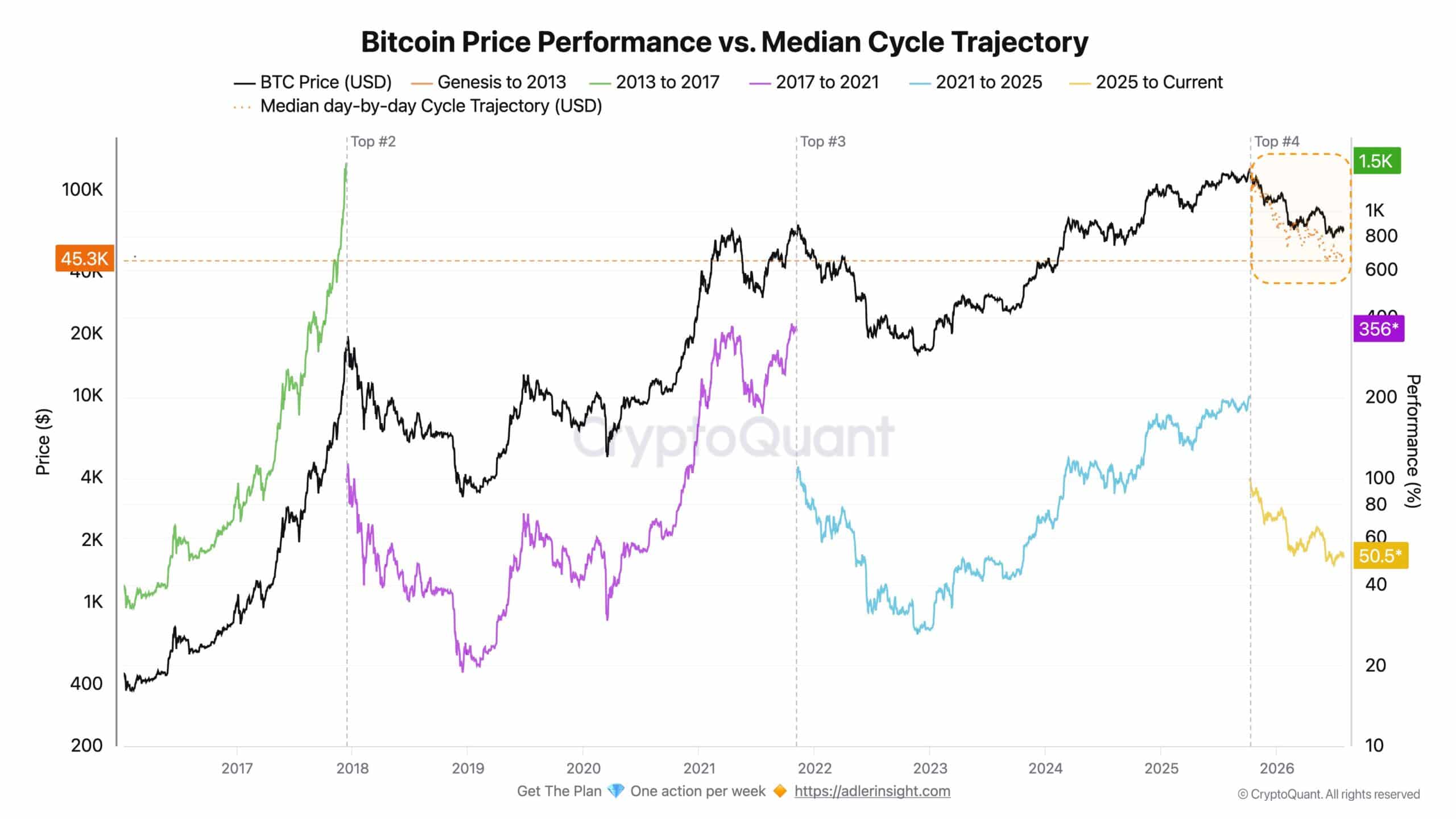
Bitcoin Price Performance
Source: CryptoQuant

On the other hand, it can also be argued that BTC is holding up relatively well. In a post on X, crypto analyst Axel Adler Jr. wrote that the current price is still close to 39% above the historical median trajectory.

Measured from the cycle’s peak, and comparing with the median trajectory of the previous three cycles, the analyst observed that $45,347 is the expected market price now.

That is not to say the price will fall to this level though, nor does it confirm that a bullish turnaround will commence. It only underlines the relatively milder nature of the bear market thus far.

The bearish challenges ahead for Bitcoin

Here, it’s worth pointing out that another sell-off might be imminent too. According to analyst Ali Martinez, Bitcoin has made negative returns in August since 2022, averaging a 10% decline on the charts.

That’s not all either as the TD Sequential printed a sell signal ahead of this month that has seen a market setback in recent years.

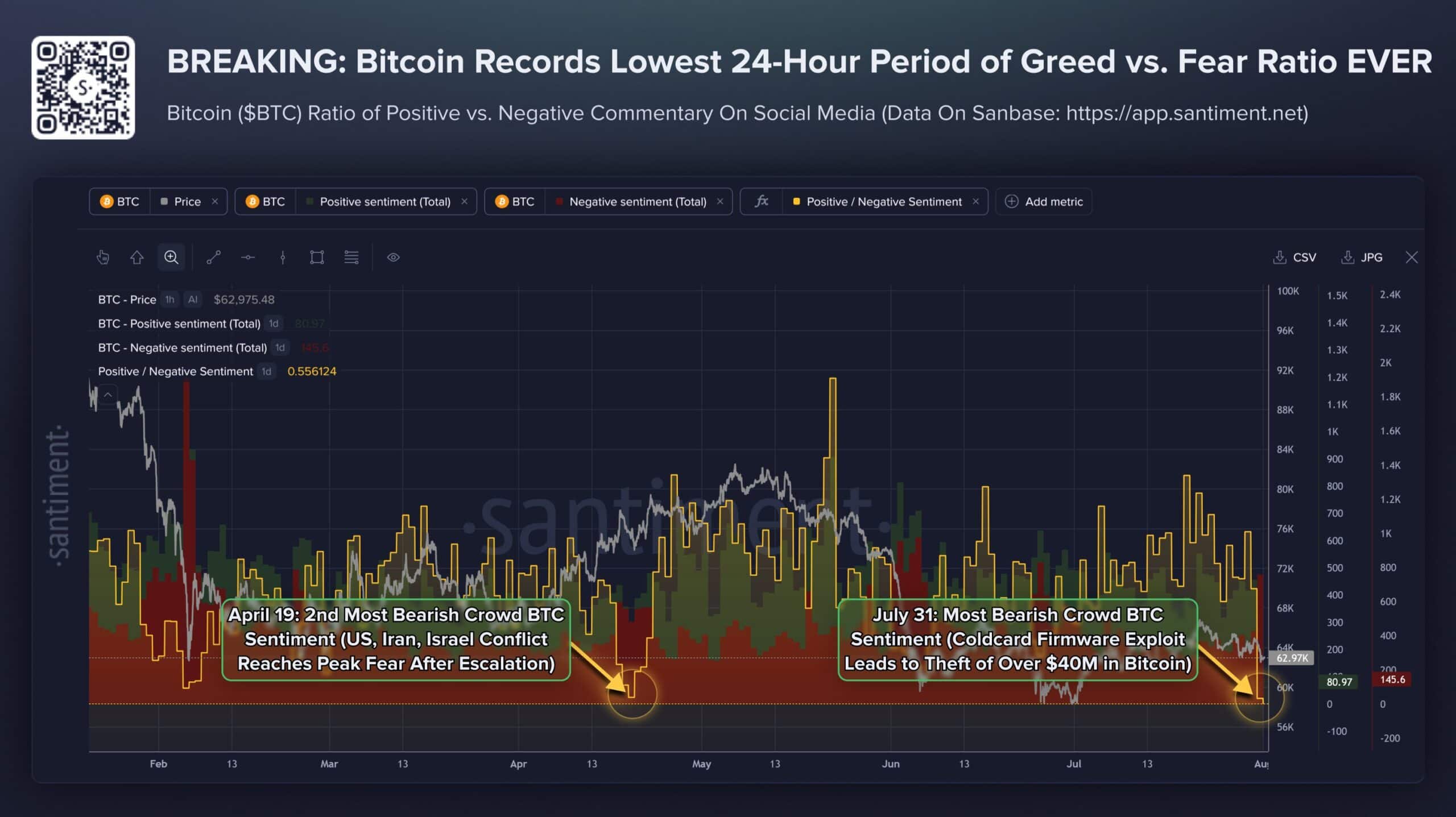
Bitcoin Greed vs Fear RatioBitcoin Greed vs Fear Ratio
Source: Santiment

Crypto-intelligence platform Santiment also observed that Bitcoin recorded the lowest positive-to-negative commentary ratio across social media platforms since Santiment began keeping records.

A big reason for the sentiment decline was the Coldcard seed flaw. The panic was even worse than the war fears earlier this year, with only 0.58 positive comments for every bearish one.

Not even the FTX implosion or COVID-19 Black Thursday, which were bigger disasters for crypto, generated such pessimistic engagement online.

Is this the time to pivot to altcoins?

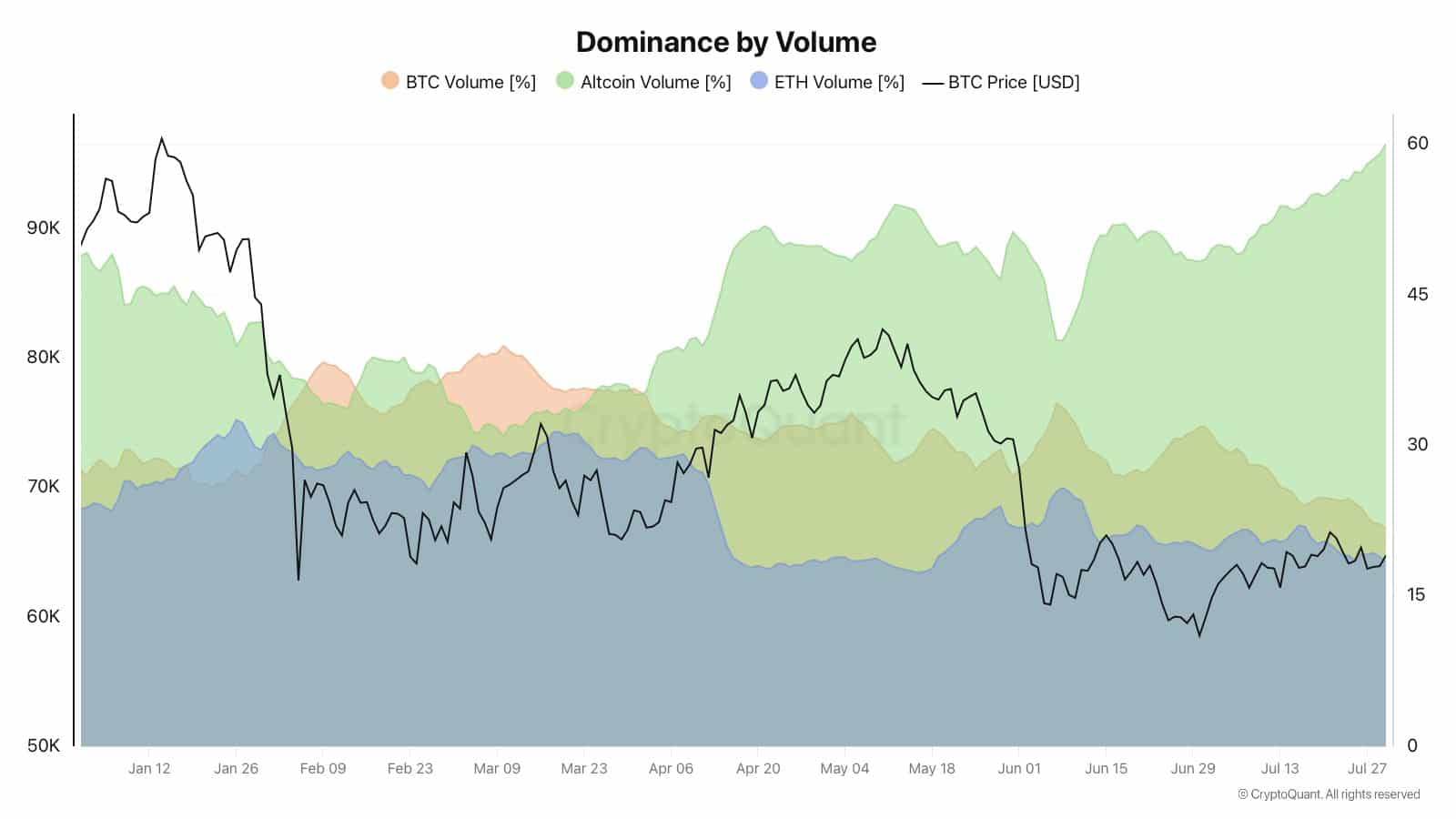
Dominance by VolumeDominance by Volume
Source: Darkfost on X

At press time, Bitcoin’s spot trade volumes on Binance were just 22% of the exchange’s total volume. Ethereum had an 18% share, with the altcoin market having 60% of the volume.

Analyst Darkfost used this signal to further highlight the lack of interest in BTC right now. Investor boredom, combined with greater drawdown for alts, might make the latter seem a more attractive buying opportunity.

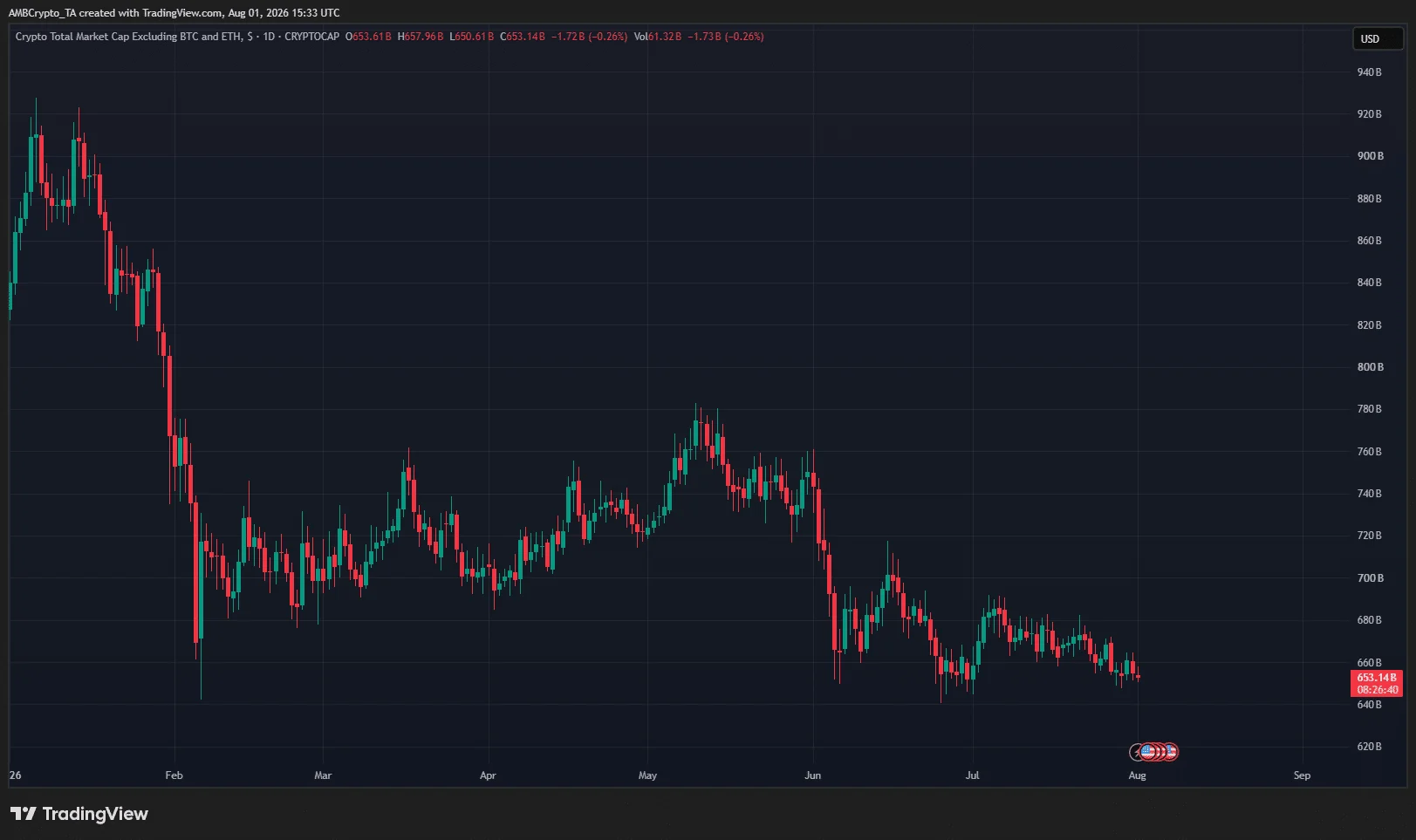
TOTAL3 on TradingViewTOTAL3 on TradingView
TOTAL3 on TradingView

This could be a risky assumption. In the event of a bearish August, most individual altcoins would likely suffer more than Bitcoin. As things stand, the altcoin market cap (excluding ETH) has been in a bearish trajectory all year.

The brief bounce in June was replaced by steady losses in July.

Traders and investors need to persevere and ride out the tough times with smart risk management and storage solutions. The sentiment hit was a big setback for the market, and only time will tell if participants will bounce back from it.


Final Summary

  • Social media engagement for Bitcoin saw the highest bearish-to-bullish commentary ratio, even worse than the war fears earlier this year.
  • Binance’s spot trading volume has been dominated by altcoins due to waning investor interest in BTC.


Source link

Bitcoin cold-wallet attack spreads to 4,500 addresses as losses near $89 million

0
Bitcoin cold-wallet attack spreads to 4,500 addresses as losses near $89 million

The attacker working through Coldcard-generated keys is now emptying wallets worth a few thousand dollars each.

Galaxy Research flagged a third wave of sweeps early Sunday, roughly 208 bitcoin drained from 1,912 addresses between Friday midday and Saturday morning UTC.

That is just over a tenth of a bitcoin per victim. The July 30 opening wave averaged close to a full coin, 1,083 bitcoin from 1,196 addresses in 41 minutes.

Observed losses across all three waves now total 1,367 bitcoin, nearly $89 million, from 4,585 addresses.

Wave three sends each victim’s coins to its own destination rather than the handful of shared collector addresses that made the first two easy to map, and parks them in pay-to-witness-script-hash outputs, a format that can carry multisignature or timelock conditions, instead of the plain single-key outputs used before.

It batched an average of six victims into each sweep where wave one took exactly one at a time, and it scanned only the default derivation path, the standard branch of the key tree a wallet checks first, instead of testing several branches per seed.


Source link

Could Buying This Financial Stock Today Set You Up for Life?

0
Could Buying This Financial Stock Today Set You Up for Life?


Robinhood Markets (NASDAQ: HOOD) stock was on a roll until last year, but it’s now 43% off its high. The financial stock is growing at a fast pace, and management continues to innovate to capitalize on its opportunities. Is the market underestimating it?

Let’s take a look at what’s driving growth, whether or not this is a rare buying opportunity, and whether or not Robinhood stock can set you up for life.

Missed Nvidia in 2009? This Rare Signal Is Flashing Again. In 2009, a “Double Down” signal flashed for a little-known chipmaker called Nvidia. For the first time in years, that same “Total Conviction” signal is flashing for a company 1/100th the size of Nvidia. Continue »

The top platform for active trading

Robinhood’s equities trading platform attracted attention as the platform of choice for the meme stock movement, and it gained admiration for its no-fee trades that bring the stock market to every retail investor. That has caught on throughout the markets, breaking down barriers in investing for the masses.

Image source: Getty Images.

It’s taking that open approach in many new directions, some of which have been more positive for the company than others. Its products have gotten riskier, like cryptocurrency trading and prediction markets. Cryptocurrency trading was propping up total revenue growth last year when Bitcoin was having a moment, but it’s been a drag this year as Bitcoin drops; segment revenue decreased 38% from last year in the second quarter.

Prediction markets, on the other hand, drove revenue growth in the second quarter. Event contracts revenue increased tenfold in the second quarter to $156 million.

Core equities trading was also fantastic in the second quarter, an outstanding quarter for the market; the S&P 500 gained 15% in the quarter, and Robinhood’s equities trading revenue increased by 95% over last year.

Becoming a financial powerhouse

Robinhood added 1.9 million funded accounts in the second quarter, a 7% year-over-year increase, which is modest growth for a young disruptor. It is converting its activated consumer base into loyal customers, though, and it added 1.5 million new customers to its Gold membership program, a 39% increase over last year.

It’s also branching out into more traditional financial products that should add more stability to its platform, which is gaining much of its growth from riskier products right now. It already offers credit cards and some banking services. It plans to roll out new products and launch in new locations, which it expects will provide constant growth opportunities.

At the current low, Robinhood stock could be an excellent bargain opportunity if you expect the company to keep growing. In 10 to 15 years, it could be a major player in U.S. finance, and buying now offers the greatest potential for gains.

However, if it continues to rely on risky products for growth, it may not take off as expected. Total revenue was growing at triple digits last year, but it increased 32% year over year in the second quarter. It isn’t adding customers at a high rate, and it’s relying on speculative activity for growth right now. That’s not a recipe for solid long-term growth.

I wouldn’t count on Robinhood setting you up for life, but if you have a strong appetite for risk, you could take a small position at the current price.

Should you buy stock in Robinhood Markets right now?

Before you buy stock in Robinhood Markets, consider this:

The Motley Fool Stock Advisor analyst team just identified what they believe are the 10 best stocks for investors to buy now… and Robinhood Markets wasn’t one of them. The 10 stocks that made the cut could produce monster returns in the coming years.

Consider when Netflix made this list on December 17, 2004… if you invested $1,000 at the time of our recommendation, you’d have $386,727!* Or when Nvidia made this list on April 15, 2005… if you invested $1,000 at the time of our recommendation, you’d have $1,232,139!*

Now, it’s worth noting Stock Advisor’s total average return is 906% — a market-crushing outperformance compared to 208% for the S&P 500. Don’t miss the latest top 10 list, available with Stock Advisor, and join an investing community built by individual investors for individual investors.

See the 10 stocks »

*Stock Advisor returns as of August 1, 2026.

Jennifer Saibil has no position in any of the stocks mentioned. The Motley Fool has positions in and recommends Bitcoin. The Motley Fool has a disclosure policy.

Could Buying This Financial Stock Today Set You Up for Life? was originally published by The Motley Fool


Source link

Bank of Italy research suggests stablecoins aren’t necessarily cheaper for remittances

0
Bank of Italy research suggests stablecoins aren't necessarily cheaper for remittances

For years, stablecoins have been marketed as crypto’s breakthrough application for cross-border payments, promising near-instant transfers at a fraction of the cost charged by traditional remittance providers.

Sending USDC across a blockchain may indeed cost only a few cents but a new study from the Bank of Italy suggests that isn’t what most people actually pay when they send money home.

In a mystery-shopping exercise spanning 10 international remittance corridors, researchers found that stablecoin-based transfers were not systematically cheaper than conventional money transfer operators once the full journey, from bank account to crypto wallet and back into local currency, was taken into account.

The study, published as Markets, Infrastructures and Payment Systems Paper No. 86, tracked transfers of 200 USDC from Italy to destinations including Argentina, Brazil, South Africa, the UAE and Japan.

End-to-end costs varied dramatically, ranging from roughly 0.3% to almost 9% of the value transferred depending on the corridor and service providers used. Settlement times also differed widely, from around 20 minutes where domestic instant payment systems supported withdrawals to as long as two business days when recipients relied on conventional bank transfers.

Blind spots

A central bank highlighting shortcoming in the promises that stablecoins may make is in some ways to be expected. Traditional financial (TradFi) institutions may have a vested interest in undermining adoption of stablecoins – digital tokens pegged to fiat currencies. Digital currencies and blockchain were designed to remove much of the need for intermediaries, such as central banks, after all.


Source link

Is Bloom Energy in Its Nvidia Moment?

0
Is Bloom Energy in Its Nvidia Moment?


Bloom Energy (NYSE: BE) just reported monster earnings on July 28 for the second quarter of 2026, but the stock price has still been wobbly.

  • July 24 opening price: $214.19

  • July 28 opening price: $175.30

  • July 29 opening price: $183.50

As of this writing, the stock price is trading at around $218 in the early morning of July 31, roughly where it was on July 24. Some of the choppiness in the recent trading activity could simply be due to Bloom’s success over the last several years. And just as with Nvidia (NASDAQ: NVDA), when a company becomes so successful, expectations become that much harder to meet.

Missed Nvidia in 2009? This Rare Signal Is Flashing Again. In 2009, a “Double Down” signal flashed for a little-known chipmaker called Nvidia. For the first time in years, that same “Total Conviction” signal is flashing for a company 1/100th the size of Nvidia. Continue »

Image source: The Motley Fool.

A dominant quarter

The energy technology company reported revenue of more than $1 billion in its 2026 second-quarter earnings report, an increase of 165.5%, and the first time Bloom surpassed $1 billion in a quarter.

Even more impressive was that Bloom reported a generally accepted accounting principles (GAAP) net profit of $196.3 million compared to a net loss of $42.6 million in the second quarter of 2025. It also showed it’s improving its operational efficiency with GAAP gross margin improving from 26.7% to 33.4%.

That report shows that demand for Bloom Energy’s technology, which provides on-site power generation, continues to grow. That should help allay some fears about slowdowns in artificial intelligence (AI) infrastructure spending, as Bloom’s sales are a sign there is still robustness out there. And with the increases in both revenue and profitability, one might think the stock price would rise after earnings. That, however, is not what happened.

The difficulty of impressing the market now

As of this writing, there are three numbers worth noting. The first is Bloom’s return so far in 2026, which is nearly 140%. The second is its return over the last 12 months, which is 453%. And the final one is 850%, which is the Bloom stock price return over the last five years.

It’s simply a stock that has delivered significant gains to its shareholders in a relatively short time. That will make it more difficult for the energy technology company to surpass earnings expectations, as it has already set the bar so high.

It’s something Nvidia has experienced itself. It was the poster child of the AI trade with its advanced chips, and in 2023 and 2024, the Nvidia stock price climbed nearly 240% and over 170%, respectively. But in 2025, it finished the year up 38.9%. So far in 2026, it’s up 4.5%, trailing the S&P 500‘s return of 8.6%.

That comparison doesn’t make Bloom a poor investment choice, nor Nvidia itself, as both companies can continue to reward long-term investors. But the point of the comparison is that it may start getting more difficult to impress the markets, and a blowout quarter may not carry the same weight for Bloom as in the past.

Should you buy stock in Bloom Energy right now?

Before you buy stock in Bloom Energy, consider this:

The Motley Fool Stock Advisor analyst team just identified what they believe are the 10 best stocks for investors to buy now… and Bloom Energy wasn’t one of them. The 10 stocks that made the cut could produce monster returns in the coming years.

Consider when Netflix made this list on December 17, 2004… if you invested $1,000 at the time of our recommendation, you’d have $386,727!* Or when Nvidia made this list on April 15, 2005… if you invested $1,000 at the time of our recommendation, you’d have $1,232,139!*

Now, it’s worth noting Stock Advisor’s total average return is 906% — a market-crushing outperformance compared to 208% for the S&P 500. Don’t miss the latest top 10 list, available with Stock Advisor, and join an investing community built by individual investors for individual investors.

See the 10 stocks »

*Stock Advisor returns as of August 1, 2026.

Jack Delaney has no position in any of the stocks mentioned. The Motley Fool has positions in and recommends Bloom Energy and Nvidia. The Motley Fool has a disclosure policy.

Is Bloom Energy in Its Nvidia Moment? was originally published by The Motley Fool


Source link