When you withdraw money from a 401(k), you probably already know that you have to consider the effect on your tax rate. Too large a withdrawal could push you into a higher tax bracket by increasing your household income. Withdrawing too much from your account could also put you at risk of draining the account if you don’t leave enough invested.
There’s another risk, though. If you aren’t careful, it’s possible that a big 401(k) withdrawal could cost you as much as an extra $487 per month for a year. That’s because of a rule many people don’t know about, and it could come as a very unpleasant financial shock.
Missed Nvidia in 2009? This Rare Signal Is Flashing Again. In 2009, a “Double Down” signal flashed for a little-known chipmaker called Nvidia. For the first time in years, that same “Total Conviction” signal is flashing for a company 1/100th the size of Nvidia. Continue »
Image source: Getty Images.
This rule means a big 401(k) withdrawal could cost you $487 a month
The rules you need to know about when it comes to a big 401(k) withdrawal relate to the cost of your Medicare premiums. Many seniors get health insurance coverage through Medicare once they turn 65, and some parts of Medicare have premiums that seniors must pay. In 2026, for example, the standard premium for Medicare Part B is $202.90 per month.
However, an Income-Related Monthly Adjustment Amount (IRMAA) is added onto your Medicare Part B premiums once your modified adjusted gross income (MAGI) goes above a certain threshold. Distributions from most retirement plans, including your 401(k), can push your MAGI above that amount.
While qualified distributions from a Roth IRA or Roth 401(k) are not part of your MAGI, withdrawals from most retirement plans do count. Your MAGI from two years prior is reviewed when setting your Medicare premiums for the year, so a large withdrawal any time at age 63 or later could result in your taxable income climbing above the threshold where you have to pay extra.
The specifics of your additional premium amount vary based on your MAGI. However, if you are a single tax filer with a MAGI of $500,000 per year or a married joint filer with an income of $750,000, your Medicare Part B premiums jump to $689.90.
That’s an extra $487 in monthly Part B premiums you would have to pay.
How to plan for large 401(k) withdrawals as a retiree
Premiums don’t just increase once your income hits $500,000 or $750,000. In fact, IRMAA kicks in at a much lower income level: Anything above $109,000 for a single filer or $218,000 for a married joint filer is going to trigger higher Part B premiums.
There may not be anything you can do about this if you need to make a distribution. But you should take this into account in your retirement planning process.
For example, you could potentially space your distributions out over two years to avoid one large withdrawal that pushes you above the threshold where premiums increase. Or you could try taking large withdrawals or even doing Roth conversions before you turn 63, since that’s the first year your income matters for Medicare purposes.
Being aware of the IRMAA rule is the first key step in developing a strategic plan, so make sure you understand these thresholds as you plan for the future.
The $23,760 Social Security bonus most retirees completely overlook
If you’re like most Americans, you’re a few years (or more) behind on your retirement savings. But a handful of little-known “Social Security secrets” could help ensure a boost in your retirement income. For example: one easy trick could pay you as much as $23,760 more… each year! Once you learn how to maximize your Social Security benefits, we think you could retire confidently with the peace of mind we’re all after.
Many Americans leave money on the table in retirement. Learn more about these retirement strategies and more, available when you join Stock Advisor.
Is the market crossing the threshold from cautious optimism to outright euphoria?
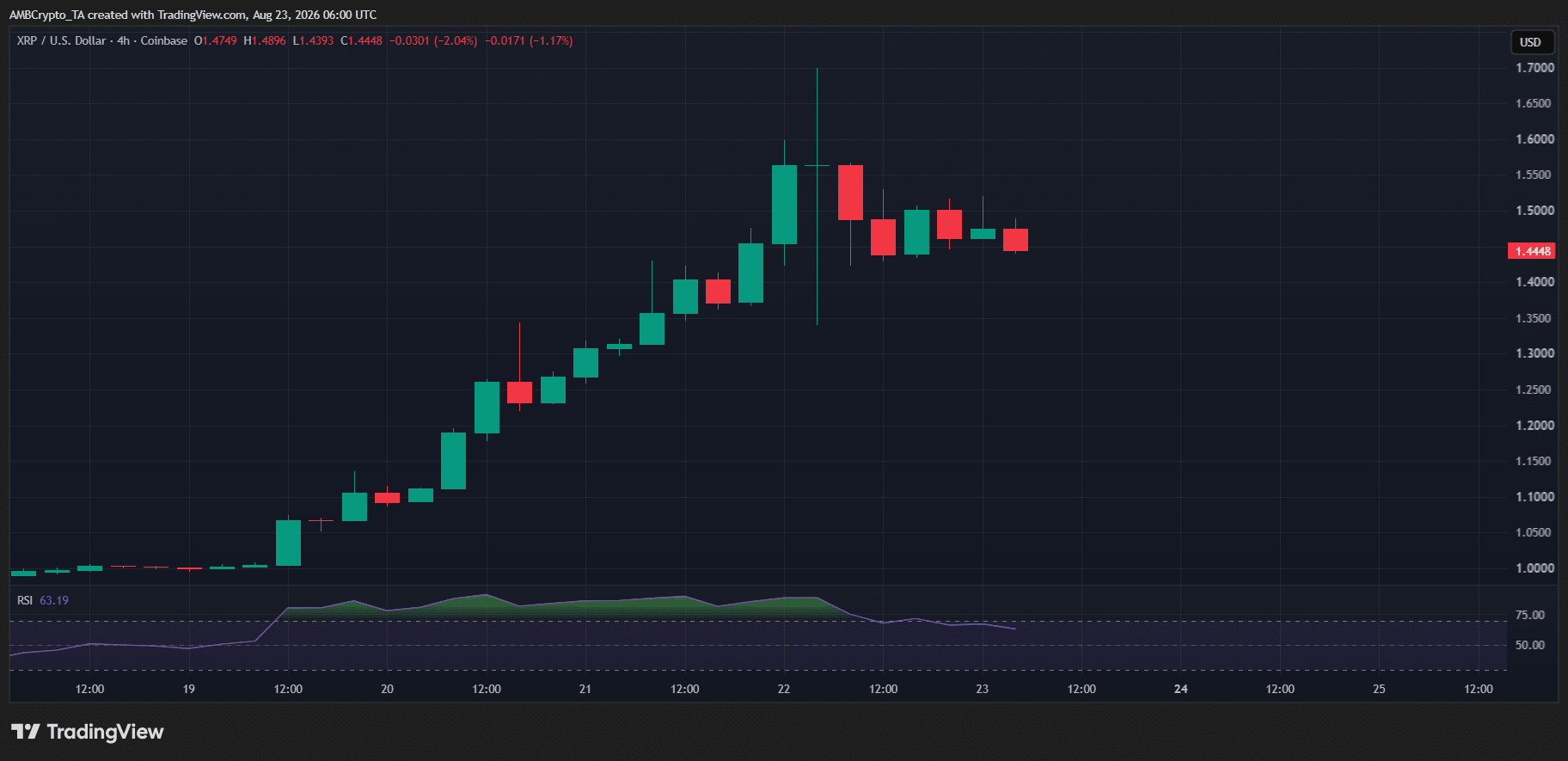
Technically, this week was the most bullish since the Q3 2025 cycle began. XRP is arguably the best asset in this regard, rising over 46% this week and forming a long upper shadow at 1.70, its highest price in more than seven months. XRP was also the best-performing large-cap asset on a weekly basis.
Nevertheless, the past 24 hours could teach optimists a lesson about the market environment. As the chart below shows, XRP closed the day at $1.46, marking a sharp 14% pullback from the $1.70 local top. Furthermore, if we consider all large-cap assets, including Bitcoin [BTC] and Ethereum [ETH], the flash crash most affected XRP. This is the most evident sign that the asset’s bullish trend could soon reverse.
Source: TradingView
The outcome? A cascading bloodbath.
According to data from CoinGlass, more than $250 million in long positions were liquidated, accounting for over 72% of all liquidations, and those traders who expected the price to continue to rise have suffered significantly. Interestingly, the market seems to have shrugged off the turmoil, with analysts believing that the price will head to $2 by the end of the third quarter of this year.
But is the market starting to outrun reality? Could Ripple’s [XRP] current setup turn into a textbook bull trap, putting more long positions at risk and leaving XRP vulnerable to a deeper correction?
XRP’s extreme optimism could spell trouble
XRP price predictions are becoming increasingly bullish, with analysts growing more optimistic.
However, technical factors currently drive the bullishness. The analyst notes that a similar setup to the 2024 XRP rally, which saw the price spike over 650%, is beginning to emerge. This is believed to indicate that further gains are likely, with many pointing towards the $2 level on social media.
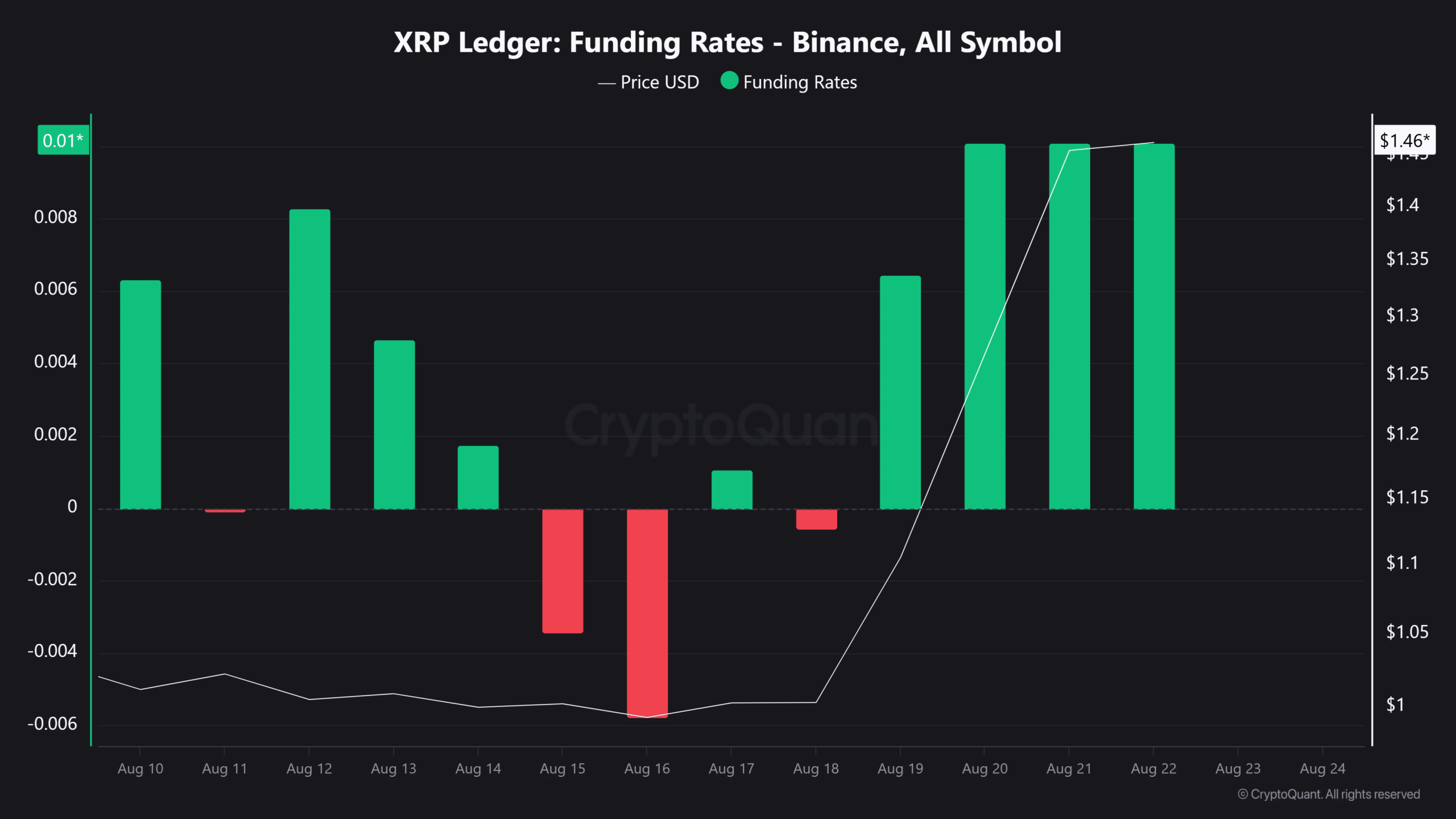
Meanwhile, it is also worth mentioning that XRP bulls are beginning to see their optimism reflected in on-chain activity. As the chart below indicates, the Binance funding rate for XRP has climbed to a two-week high of 0.01%, suggesting that traders are beginning to deploy more aggressive long positions.
Source: CryptoQuant
While funding rates being positive are generally bullish, it is crucial to note that rates climbing too quickly can be a sign of market weakness. If too many traders are opening long positions at once, there is likely to be a wave of liquidations should the price move sharply lower.
Notably, this appears to be what has happened over the last 24 hours, with the XRP price falling nearly 14%, the largest drawdown among top high-caps. Plus, over $250 million in long liquidations have occurred as traders scramble to reduce their exposure. This development could serve as a much-needed “reality check” for XRP after its roughly 45% weekly increase, which may have caused some traders to feel overly bullish.
As such, technical indicators may not always be reliable, and in the case of XRP, the growing number of longs may very well lead to a bull trap before the price breaks out towards $2.
Final Summary
XRP’s 46%+ rally has made traders very bullish. However, rising longs and funding rates show the market may be overheating.
The recent 14% drop and $250 million+ in long liquidations could be a warning of a bull trap before the next move toward $2.
Major supermarket chains, including Kroger, Stop & Shop, and The Raley’s Companies, are in the middle of a downsizing mode that began in 2025 and will continue for some companies through 2027.
Kroger said it expected to close approximately 60 stores across its portfolio by the end of 2026, according to the company’s first-quarter fiscal 2025 earnings call. Giant Ahold Delhaize’s Stop & Shop chain confirmed in July that it will close store locations in Basking Ridge and Westfield, N.J., also in 2026
And now Raley’s has said that it will close another Northern California store located in Petaluma, Calif., on Jan. 26, 2027, affecting 48 workers’ jobs.
The Raley’s Companies will close six stores in California and one in Nevada.Kimberly White / Getty Images
Raley’s closes 7 stores
The closures are part of Raley’s regional downsizing plan that calls for seven store closings in California and Nevada. Raley’s said it will offer transfer opportunities to as many affected employees as possible, KSRO radio reported.
The Raley’s Companies cited local market conditions and long-term financial sustainability for the downsizing.
The West Sacramento, Calif., grocery store chain began its downsizing plan with the closing of its Raley’s store in Roseville, Calif., in January 2026, followed by the closure of its store in Antioch, Calif., in April. The chain had allowed both store leases to expire.
The supermarket chain continued closing stores by shuttering a Nob Hill Foods store in Mountain View, Calif., on May 29, 2026, affecting 50 employees.
Underperforming store leads to closure
Raley’s followed up its Mountain View closure with the announcement that it will close its Nob Hill Foods store in Los Gatos, Calif., when its lease expires in June 2027, after reviewing the store’s performance and current economic conditions, the company’s Chief Marketing Officer Carol Barsotti said.
The company also plans to close its Raley’s store in Brentwood, Calif., on Nov. 3, 2026, and an Elko, Nev., location in December 2026, according to SFGate.
“Thoughtful stewardship sometimes means opening stores and sometimes it means making difficult decisions to close them,” The Raley’s Companies spokesperson Chelsea Carbahal told SFGate.
Foot traffic, sales impacted
Raley’s brick-and mortar locations have faced more competition with online marketplaces and changing customer preferences, which impacted store foot traffic and overall sales, Carbahal said.
Despite the downsizing plan, Raley’s plans to open a new store in March 2027 in the Central Valley city of Madera, Calif.
Raley’s opened its first grocery store in Placerville, Calif., in 1935 and grew in California and Nevada before expanding to more states through grocery store acquisitions.
The chain formed The Raley’s Companies in 2021 after the purchase of the Bashas Family of Stores. It currently operates about 235 grocery stores in seven states and four tribal nations under its brands, including the Raley’s, Bel Air, Nob Hill Foods, Raley’s O-N-E Market, Bashas, Bashas Dine, Food City, and Eddie’s Country Store brands, according to its website.
Grocery stores face challenges to remain profitable, including competition from regional and national supermarket chains, rising costs of products and labor driven by inflation, consumers’ changing attitudes toward products, and lease rates that don’t make economic sense.
Stores face revenue challenges
Supermarkets faced increased food-at-home inflation after the 2020 Covid-19 pandemic, rising by 11.4% in 2022 and 5% in 2023, while revenue peaked only 0.5% higher in 2022 year-over-year, before falling below 2021 levels in 2023 and 2024 and recovering in 2025, according to data from IBISWorld.
Store closings even hit a chain that had never closed a store before. 78-year-old grocery chain operator, Cosentino’s Food Stores closed its Price Chopper location in Overland Park, Kan., in February, marking the first store it has closed in its history.
Cosentino’s operates 24 Price Chopper, three Sun Fresh, three Cosentino’s Markets, two Apple Market, and a Market 48 Liquor store.
A mysterious new AI model is making the rounds among developers — and nobody is saying who built it.
Ox Alpha appeared on OpenRouter on Thursday as a “stealth model” from an anonymous third-party provider. OpenRouter describes it as a “reasoning model designed for coding, sustained agentic work, and production workloads. It is suited for long-horizon software engineering, complex reasoning, and workflows that combine text with visual context.”
It’s also free.
OpenCode, an open-source AI coding agent, said on X that Ox Alpha would be free for a week with “near unlimited usage” and that its provider had capacity for 100 trillion tokens per day, which is roughly 100 times the number of AI tokens Visa said it uses in an entire month.
Ox Alpha has already attracted interest from prominent tech figures. Stripe CEO Patrick Collison tried the model and said in a post on X that “it’s very impressive.”
Early speculation suggests it may be the product of a Chinese AI lab. Wccftech, an online tech publication, suggested that the Chinese lab behind GLM-5, Z.ai, as one possibility, noting that the company previously tested GLM-5 anonymously under the name “Pony Alpha” and that developers have identified similarities in Ox Alpha’s tokenizer behavior and responses.
That speculation comes as Chinese AI labs like Zhipu, DeepSeek, and Moonshot AI increasingly challenge US rivals. Models from those companies have approached the performance of leading American systems at a fraction of the cost and are largely open-source.
Moonshot’s Kimi K3, released in July, is a 2.8 trillion-parameter open-weight model built for coding, reasoning, and agentic tasks that quickly drew attention in Silicon Valley for its performance and lower price.
Still, the evidence is far from conclusive.
Wccftech later highlighted a competing analysis suggesting Ox Alpha’s tokenizer could instead point toward Microsoft’s MAI family.
On Saturday, Andrew Curran, a prominent AI analyst, wrote on X that GLM had been the leading theory on Friday night, but by Saturday morning, “people seem less sure of anything.”
Polygon [POL] is up by more than 31% in the past 24 hours, but bulls appear not to be holding onto the new strength in the crypto market. At the time of press, Polygon’s 31% gains had dropped to about 18%, while daily trading volume surged 133% to about $365 million.
Network activity has been the key driver of Polygon, supported by a broader, stronger risk-on sentiment in the crypto markets. But can POL bulls keep buying the token and sustain this rally?
Why is Polygon surging so hard?
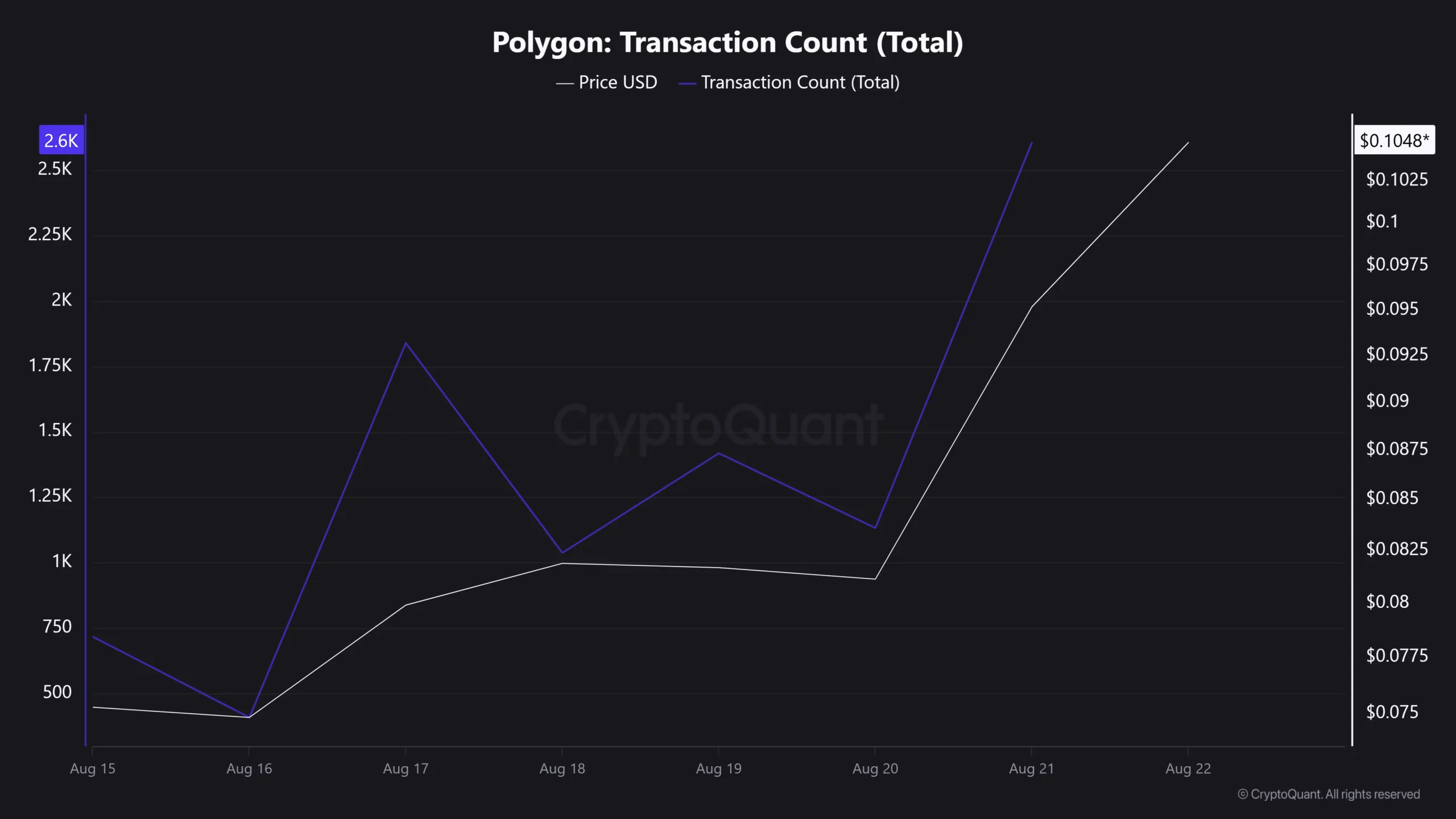
Getting into the details, Polygon’s Transaction Count rose from 407 to 2,606 over this week, aligning with the price recovery. This was equivalent to more than 6x growth.
Source: CryptoQuant
Even so, Active Addresses doubled over the same span, rising from 161 to 286. This reading reinforced consistent network usage.
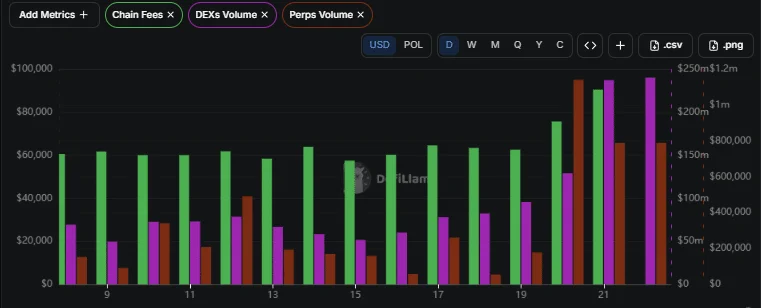
The chain’s DEX and Perps volume have also continued to rise sharply. On the 9th of August, DEX volume was at $50 million, while Perps volume was at $91K.
Two weeks later, DEX volumes have increased fivefold to $240 million, while Perps have surged by 8.6x.
Source: DeFiLlama
Fundamentally, they increased their stablecoin settlements, which is their main business currently. Polygon integrated the settlement of Frax’s frxUSD-based FX pools, making multi-bank currency conversion nearly instant.
However, USDC remains the dominant stablecoin on the chain with a 54% share. Its stablecoin market cap grew to $3.035 billion, as per DefiLlama.
As a result, chain fees have grown from $60K to over $90K over the same period.
Can bulls continue buying past $0.12?
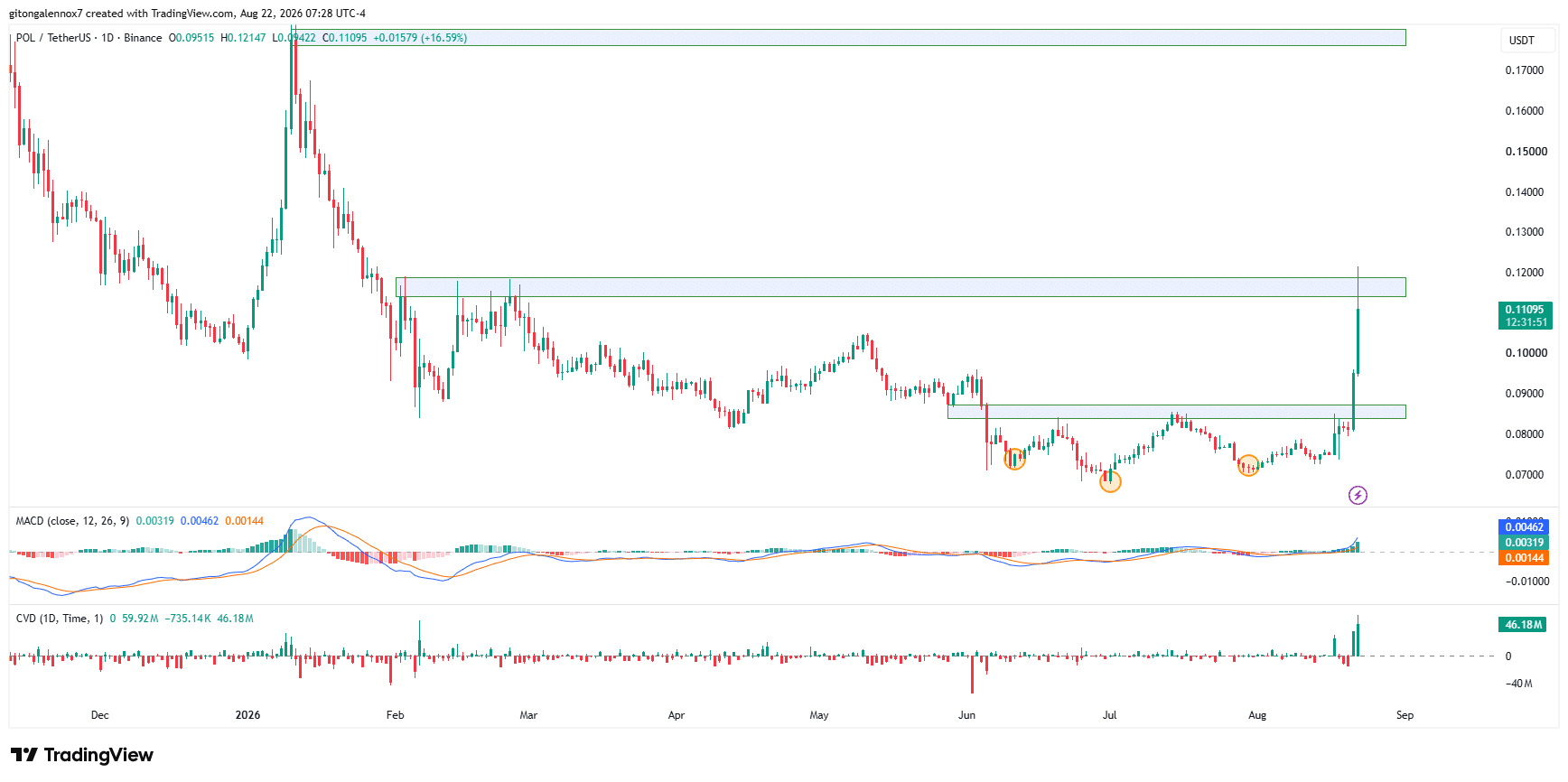
On the charts, POL was trading above $0.085, the neckline of an inverted heads-and-shoulders pattern. This indicated that the altcoin’s market structure was shifting to bullish.
However, POL was facing resistance around $0.12, as bears at this supply zone reduced the gains. Such conditions could force a correction so as to find strength before moving toward $0.18.
The MACD has turned green, indicating bulls are still in control. The CVD showed that net trading activity was buying, with over 46 million POL tokens withdrawn from the Binance spot market.
Source: POL/USDT on TradingView
Despite the bullish activity, the instant rejection at $0.12 hinted at a potential pause in the intense buying activity. That could result in a correction but remains bullish unless the $0.085 support is lost.
Final Summary
Polygon surged over 31% in the past 24 hours, driven by a stronger crypto market and growing network activity.
Polygon broke above a bottoming pattern, but its uptrend toward $0.18 faces resistance at $0.12.
If there’s a habit I’ve picked up from watching markets, it’s that when everyone is looking at the loudest trade, I start wondering what’s happening in the quiet corners.
The biggest clues aren’t always found in a soaring stock that’s already overvalued or a famous analyst calling for a breakout. Sometimes they’re buried somewhere else that investors never bother to open. I’d put this one in the last category.
The latest 13F filing from the Bill & Melinda Gates Foundation Trust shows a new $352.7 million position in The Home Depot (HD). At the same time, the trust cut its stake in Berkshire Hathaway by about $818 million.
That’s not pocket change, and it’s certainly not the kind of portfolio move I’d scroll past without asking why.
Why? This is big money moving from one of the market’s most iconic investments into a home-improvement giant. There must be a story hiding underneath the numbers. The trust just bought the shares while everyone else seems to be waiting for the housing market to come back to life.
The trust now holds 1 million shares of The Home Depot. That’s a meaningful opening position for a portfolio with $34.42 billion in managed 13F securities, according to WhaleWisdom.
And it arrives at a moment when The Home Depot just delivered its strongest comparable sales growth since 2022, despite what its own CFO describes as “frozen housing market conditions.”
Why Gates Trust trimmed Berkshire and opened The Home Depot
The Gates Foundation Trust’s portfolio is concentrated and deliberate. Its top five holdings include Berkshire Hathaway Class B (BRK.B), Caterpillar (CAT), Canadian National Railway (CNI), Waste Management (WM), and Deere & Company (DE), according to GuruFocus data.
These are long-duration bets on essential infrastructure, industrials, and American economic activity.
The Home Depot fits that same framework anyway. It’s the world’s largest home improvement retailer, tied directly to the American housing stock, The Home Depot reports.
More Retail:
The trust also opened a new position in FedEx Freight Holding Company (FDXF) worth approximately $180 million in the same quarter, according to the 13F filing. That’s another infrastructure-adjacent business that I’ll most likely cover next.
My understanding is that the trust is rotating toward companies that benefit from domestic economic activity and physical asset maintenance rather than purely financial holdings. Call me crazy, but that sounds like a pretty interesting investment thesis.
What The Home Depot’s Q2 results show about why this bet makes sense now
The Home Depot reported Q2 fiscal 2026 results on Aug. 18 that beat expectations across the board.
Net sales of $47.9 billion, up 5.7% year-over-year (YoY)
Comparable sales growth of 1.7% — the highest since 2022
Adjusted diluted EPS of $4.92, up from $4.68 in the prior year period
Net earnings of $4.8 billion, or $4.79 per diluted share
CFO Richard McPhail was candid about the environment in a CNBC interview.
“We continue to operate in what I call frozen housing market conditions,” he said. “But we also know that we’re taking share and that we’re serving our customers better every day.”
That phrase — taking share in a frozen market — is the crux of the investment case. The Home Depot’s comparable sales growth isn’t being driven by a housing recovery. It’s being driven by smaller, non-discretionary repair and maintenance projects that homeowners undertake regardless of whether they’re buying or selling.
When a roof leaks or a water heater fails, it gets replaced. Like it or not, The Home Depot captures that spending whether mortgage rates are at 3% or 7%.
The company also received $730 million in tariff refunds during Q2, using $685 million to reduce cost of goods sold, according to McPhail’s comments on the earnings call.
That pass-through to customers mirrors Walmart’s own approach to tariff refunds, as I noted in my previous coverage, highlighting a broader pattern among major retailers navigating the current trade environment.
BofA’s read on why the stock’s underperformance creates an opportunity
Bank of America analyst Christopher Nardone reiterated a Buy rating on The Home Depot and adjusted his price target to $407 from $412, according to a note shared with my colleague at TheStreet.
The modest target reduction reflects the cautious guidance The Home Depot reaffirmed rather than raised. But the Buy rating holds.
The Home Depot’s reaffirmed fiscal 2026 guidance calls for total sales growth of 2.5% to 4.5% and comparable sales growth of flat to 2.0%, according to The Home Depot. Gross margin is projected at approximately 33.1%, with operating margin between 12.4% and 12.6%.
McPhail described the customer as “a healthy cohort” who has “the means to spend” but remains hesitant as projects get larger, citing inflation, fuel costs, and general uncertainty, according to his CNBC interview.
That hesitancy is real, but it’s also temporary. The deferred maintenance and renovation spending building up in the U.S. housing stock doesn’t disappear. It accumulates.
The latest 13F filing from the Bill & Melinda Gates Foundation Trust shows a new $352.7 million position in The Home Depot (HD).David Paul Morris/Bloomberg via Getty Images
This is how The Home Depot has performed lately
HD shares were trading at $334.49 as of Aug. 20, down 1.41% year-to-date and 14.53% over the past year, according to Yahoo Finance. That’s roughly $18 down from where Gates opened their buy position.
My read is that the Gates Foundation is buying The Home Depot at a point of maximum pessimism about housing.
Bank of America’s $407 target implies roughly 22% upside from current levels. The Gates Foundation, apparently, agrees with the direction.
The fast-food fried chicken space has several contenders vying for the throne. Chick-fil-A has been a market leader, but Popeyes has competed with its once-viral chicken sandwich, while Raising Cane’s has grown quickly, fueled by its cult fanbase and simple menu.
It’s an incredibly competitive space where it’s hard to differentiate your product.
The chicken category increased 5.3% in 2025, down from 9.1% in 2024 and more than 12% in 2023, according to Technomic data shared with Nation’s Restaurant News.
“Last year, the category was especially impacted by slowing momentum for the biggest players. Chick-fil-A’s sales grew 5.2% year-over-year, compared to 5.4% in 2024, for instance,” NRN reported.
Two of the biggest names in the space actually saw sales drop.
“Popeyes’ sales fell 0.5% in 2025, versus 3.9% growth in 2024. KFC had a tough 2025, with sales down 4.6%, while in 2024, its sales were down 5.2%,” the data showed.
That’s a significant drop over a two-year period for KFC, which may explain why the chain has been closing stores.
KFC has closed 300 stores in a year
While much of the attention has been focused on KFC’s former sister brand, Pizza Hut, which was sold by Yum Brands in June, the chicken brand has also been struggling, but it has shown signs of a signifcant turnaorund.
“KFC delivered 6% system sales growth driven by 7% unit growth and 2% same-store sales growth. Around the world, KFC teams are advancing our Raise the B.A.R. priorities, beginning with improving menu relevance,” Yum Brands CEO Christopher Turner said during the chain’s second-quarter earnings call.
More Restaurants:
Closing underperforming stores can also improve a chain’s overall sales performance by removing weaker locations.
“An analysis of KFC finds that at least 312 of its U.S. restaurants have permanently closed between July 15, 2025, and July 6, 2026, a 7.64% reduction in the size of the chain’s American footprint,” according to Local Falcon.
Local Falcon, a local AI search visibility platform, compared KFC’s public store locator at the start and end of the period. Each restaurant listing that had been removed and returned a 404 error was then independently verified against Google Maps.
KFC has made increased value part of its turnaround plan. Yum Brands
KFC needs an identity boost
KFC’s struggles come partially because its rivals including Chick-fil-A, Popeyes, and Raising Cane’s have staked out distinctive brand positions. That’s something KFC has abandoned, according to RTM Nexus CEO Dominik Miserandino.
“For decades, KFC relied on a legacy model: selling heavy, family-sized buckets of bone-in chicken for dinner. But consumer habits shifted fast toward portable, single-serve convenience,” he told TheStreet.
That allowed other chains to usurp its market-leading position.
“Chick-fil-A dominated that shift by perfecting drive-thru speed, customer service, and the classic chicken sandwich. Then Popeyes swooped in and proved you could deliver high-flavor, premium-tier fried chicken with speed and scale,” he added.
It was also a matter of brand connection and staying ahead of what customers wanted.
“While Chick-fil-A and Popeyes built fanatical followings, KFC stayed stuck in the past with slow, complex bucket meals and outdated stores. By the time KFC tried to pivot to chicken sandwiches and nuggets, the category leaders had already locked up consumer loyalty. KFC got squeezed into the background because they treated chicken like a Sunday family dinner while their competitors treated it like a fast, daily habit,” he shared.
KFC has made changes
Turner has been leading a turnaround effort at KFC. That includes a visual reboot for restaurants, as well as the launch of the Saucy sister brand. Lessons learned from the fledgling chain are being applied to the flagship brand.
“If you think about battling for the future consumer, just a couple of months ago, we introduced the new brand visual identity. You’re going to be seeing that come to life in our imaging and as the brand presents itself around the globe,” he said.
Turner also promised improvements in the chain’s food.
“You’ve heard us talk about leveraging the learnings from Saucy to improve our tender formulation. We’re going to have larger tenders, more craveable tenders. We’re bringing the range of sauces, dips, drips and, sorry, sauces, dips and rubs to life to give more flavors to our consumers,” he added.
Restaurant consultant Jeffrey Summers wrote in his LinkedIn page that KFC went from seven consecutive quarters of negative same-store sales to back-to-back positive quarters, but cautioned that the improvement was still modest.
“The turnaround required: a new president, a new CMO, a new chief growth officer, a national campaign admitting failure, the return of Potato Wedges, a viral social media moment, a tiered value architecture borrowed from Taco Bell, and two years of work,” he posted.
That brought the chain a 1% gain in same-store sales.
“I am not saying that to diminish what Catherine Tan-Gillespie and her team accomplished. Turning a $5 billion brand with 3,500 locations is genuinely hard work. The admission that Colonel Sanders would not be happy about where the brand had gone was honest and brave and it worked,” he added.
KFC, however, does face a challenging market.
“The total number of chicken chain locations has surged by 46% over the last decade, reflecting a net increase of nearly 6,200 units — a market response to a clear demand for the protein,” NRN reported.