electricity power lines sunset clouds by Analogicus via Pixabay
Utility stocks have long been viewed as dependable investments, valued for their defensive characteristics, resilient earnings, and reliable dividend income. However, the artificial intelligence (AI) boom has fundamentally changed that narrative. As hyperscalers such as Microsoft (MSFT), Alphabet (GOOG) (GOOGL), Amazon (AMZN), and Meta Platforms (META) race to build AI data centers, electricity demand is rising at its fastest pace in decades, turning many utilities into structural growth stories.
That shift is becoming increasingly evident in corporate earnings. Utility companies have delivered another strong round of quarterly results, with most beating Wall Street’s earnings expectations. Management teams across the sector have also reaffirmed ambitious investment plans, highlighting growing pipelines of AI-related projects that are expected to drive earnings growth well into the next decade.
More News from Barchart
So, what is the best way to invest in the utility sector’s AI-driven transformation? Let’s take a closer look at my favorite way to play the data center boom.
www.barchart.com
Utilities Are No Longer Boring as AI Power Demand Surges
Investors have traditionally viewed utility stocks as defensive investments, offering steady growth and attractive dividend yields. Demand for essential services such as electricity and natural gas tends to remain resilient across economic cycles, supporting stable earnings and reliable dividend payouts. The S&P 500 Utilities Index ($UYB) had its best year at the onset of the dot-com crash in 2000, gaining 52% while the broader S&P 500 ($SPX) fell 10%. Utilities also beat the broader market during the global financial crisis in 2007 and 2008, as well as in 2022, when the S&P 500 tumbled after the Federal Reserve began its rate-hiking cycle.
However, utilities are no longer the boring sector they once were. The AI boom has dramatically reshaped that profile, effectively transforming once-sleepy utility stocks into structural growth plays. AI data centers require enormous amounts of electricity to operate. Unlike many traditional commercial customers, data centers consume power around the clock. With that, the companies generating and supplying that power are benefiting alongside those developing and deploying AI.
Of course, utilities are not expected to deliver earnings growth on par with some of the hottest areas of the AI trade, such as chipmakers. That is partly because many utilities have substantial non-data center operations that typically generate low- to mid-single-digit earnings growth. However, the stability provided by these businesses also makes utility stocks less volatile than the broader market. For example, most utilities have betas well below 1, meaning their daily price movements have historically been less pronounced than those of the S&P 500.
Many utilities with data center exposure are positioned to deliver high-single-digit to double-digit earnings growth for years to come. That is solid growth that should support further gains in their share prices with limited volatility. This combination of solid growth and relative stability has been attracting investors seeking exposure to the AI boom without the extreme price swings seen in many other AI-related stocks.
The Data Center Boom Is Reshaping Utility Capital Spending and Profits
As the data center buildout continues, many utilities are reporting the strongest demand growth they have seen in decades. To meet that surging electricity demand, utilities plan to spend massive sums, such as a projected $240 billion in 2026 and $1.4 trillion over the five years through 2030, on grid upgrades and transmission infrastructure. Under traditional regulation, these capital investments expand a utility’s regulated asset base, allowing them to earn a government-approved rate of return on those physical assets.
Morningstar analysts expect electricity demand from data centers to quadruple by 2030 and increase sixfold by 2035. They estimate that data center-related electricity demand could account for 24% of total U.S. electricity demand by 2030, rising to as much as 34% by 2035. With that, data centers are expected to contribute an increasingly large share of utilities’ earnings growth.
Meanwhile, the AI tailwind is already showing up in earnings. Of the 16 S&P 500 utilities that reported quarterly results last week, 12 beat earnings expectations. On the revenue side, 10 topped Wall Street estimates. This week, the picture was more mixed. Duke Energy (DUK) beat earnings estimates but missed on revenue, NiSource (NI) reported adjusted EPS in line with expectations while topping revenue estimates, and NRG Energy (NRG) missed Wall Street forecasts on both earnings and revenue. Consolidated Edison (ED), Sempra (SRE), and PPL Corporation (PPL) are scheduled to report their quarterly results later this week.
How to Play the Utility Sector’s Data Center Tailwind
The simplest way to play the utility sector’s data center tailwind is by buying the State Street Utilities Select Sector SPDR ETF (XLU). The fund holds 31 S&P 500 companies across electric, multi-, gas, water, and independent power utilities, including NextEra Energy (NEE), Southern Company (SO), Duke Energy,Constellation Energy (CEG), and American Electric Power (AEP). XLU combines growth potential with defensive and income characteristics. Its holdings are expected to generate average annual earnings growth of about 9.7% over the next three to five years, while the fund offers a dividend yield of 2.71% and pays quarterly dividends. With an expense ratio of just 0.08%, XLU offers a low-cost way to gain diversified exposure to large U.S. utility companies.
If you prefer picking individual stocks, I believe DTE Energy (DTE) could be a compelling choice. CEO Joi Harris recently reaffirmed the company’s long-term outlook, stating, “We are confident in our long-term operating EPS growth rate target of 6% to 8% through 2030,” and added that “the Google data center project and other data center opportunities provide upside to this plan.” Morningstar analysts project average annual earnings growth of 7% through 2030, with the potential to exceed 8% if DTE secures a third hyperscaler data center customer later this year. It is also worth noting that DTE trades at a forward adjusted P/E of 18.38x, roughly in line with both the sector median and its five-year average, while prominent peers such as American Electric Power and Alliant Energy (LNT) trade at premiums to the sector median. In addition, DTE offers a dividend yield of 3.29%, higher than XLU’s yield. Finally, the stock currently trades at a key support level from which it has bounced several times this year. If that level holds, another rebound could offer investors attractive upside over the near term.
On the date of publication, Oleksandr Pylypenko had a position in: MSFT, GOOGL, AMZN, META. All information and data in this article is solely for informational purposes. This article was originally published on Barchart.com
There is already money on the chain for the feature to serve. Onchain data aggregator RWA.xyz tracks about $1.38 billion of distributed real-world assets on XRPL, including $845.7 million of RLUSD. Ondo accounts for another $212.6 million, followed by VERT Capital at $116.1 million and Archax at $55.4 million. Societe Generale sits further down the table at $11.6 million.
Tokenized real-world assets issued on the XRP Ledger. (Shaurya Malwa/CoinDesk)
That leaves more than $530 million of tracked tokenized assets outside RLUSD, though the market remains concentrated in a handful of issuers.
Confidential Transfers stays narrow in its first version. Holders have to opt into the encrypted format, and it currently works for direct MPT payments between accounts. It does not cover trades on XRPL’s built-in exchange, escrow or checks.
The other five are aimed at the same audience. Batch can package as many as eight transactions together, including an all-or-nothing mode where every step succeeds or none does. Sponsor lets one account cover another’s fees and reserve requirements, removing the need for a new user to hold XRP before transacting.
Permission Delegation lets an account authorize another party to submit only specified transaction types, giving a fund administrator limited authority without handing over full control. Dynamic MPT lets issuers change certain properties of a token after issuance.
Cardano [ADA] is among the top blockchains across the globe and recently hit a new peak in the Nakamoto coefficient of 16. This put Cardano as one of the most decentralized chains as prices slowly rebound.
The altcoin has surged by more than 19% this week with daily gains averaging more than 6%. These gains resulted from Cardano transitioning to the Dijkstra development era. Can the price keep surging?
Dijkstra launch fuels Cardano’s weekly gains
According to CoinMarketCap, Cardano came a distant second among the largest weekly gainers. SKYAI recorded 261% with MemeCore [M], Humanity Protocol [H], and Pieverse [PIEVERSE] wrapping up the top 5 list for this week.
Source: CoinMarketCap
Cardano’s transition to the Dijkstra development era drove these weekly gains. This was a newly approved roadmap that made it the first chain to fund core development directly from its treasury.
Additionally, the ecosystem was expanding to other blockchains. For instance, the chain connected with Injective [INJ] via The Inter-Blockchain Communication Protocol (IBC), which was on testnet. Both INJ and ADA will be usable across the two ecosystems.
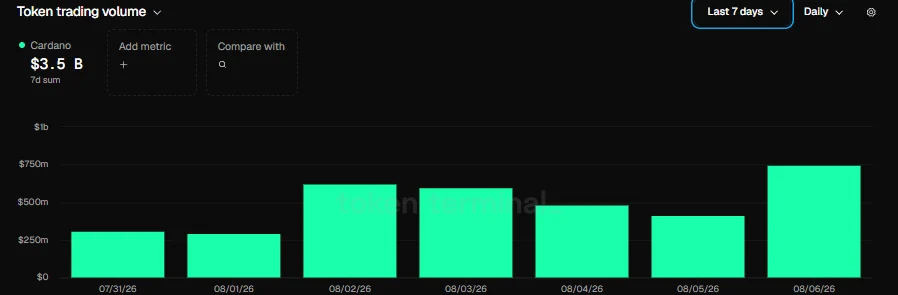
As a result, the daily trading volume has also jumped by more than 78%, recording about $747 million. It jumped from $412.8 million to A 7-day sum of $3.50 billion.
Source: Token Terminal
Furthermore, the Total Value Locked (TVL) rose by around 3%, reaching $88 million. The chain’s weekly DEX volume also increased by 17%, reaching $13 million.
Moreover, such developments prompted the big players to position themselves. According to Santiment data, whales have accumulated over 240 million ADA in the past few days.
Can ADA stay above $0.20?
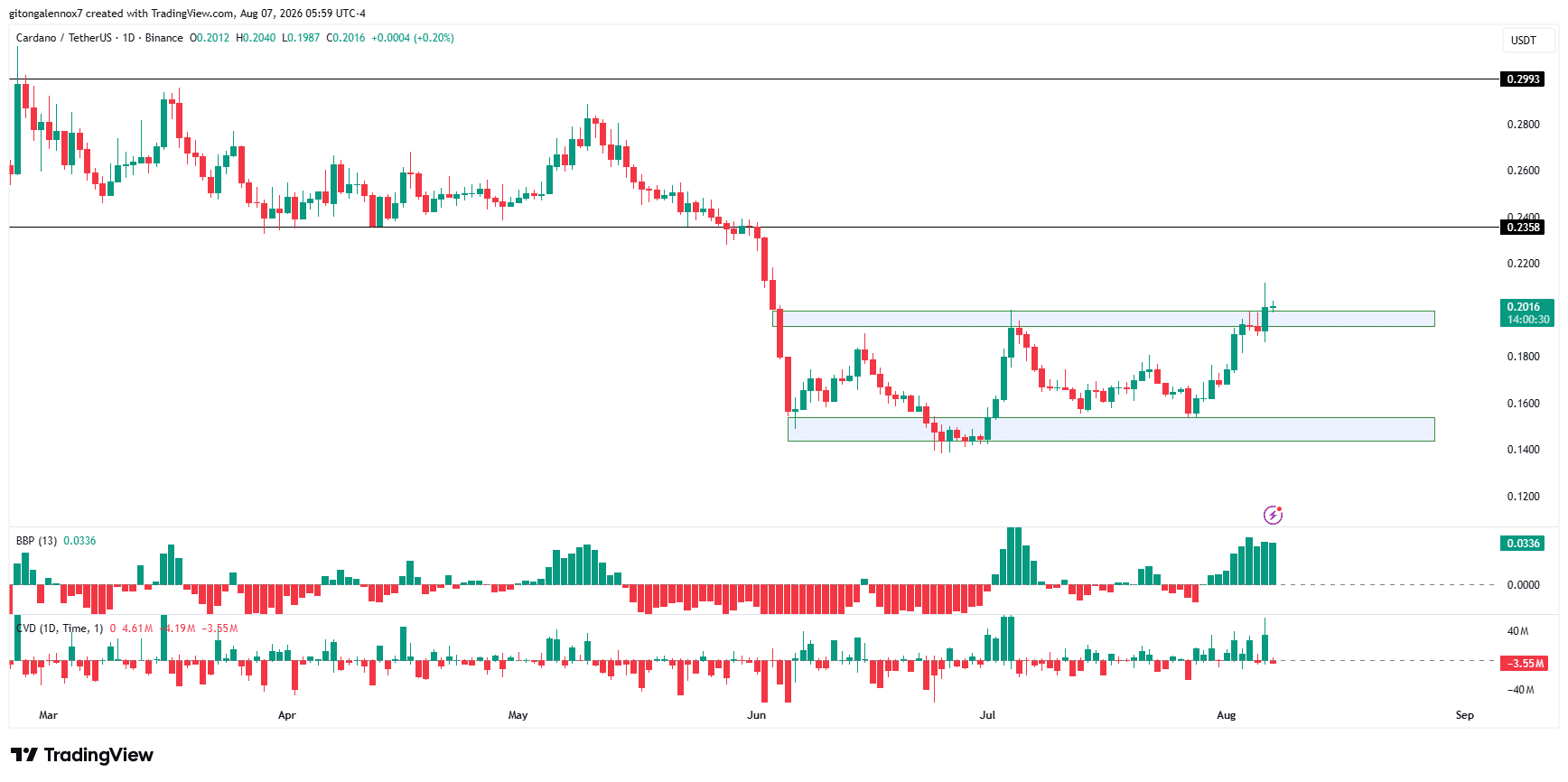
Meanwhile, Cardano’s price broke above the $0.20 resistance level, but there was some lag at this zone. The altcoin price has been ranging between $0.14 and $0.20 since July, aligning with whale positioning. The range followed a 41% sharp drop from $0.24 to $0.14.
In support of this trend was the Bull/Bear Power indicator, which turned green. The CVD showed that traders on Binance’s spot market bought more than 40 million ADA tokens.
With the token clearing the $0.20 resistance that capped every recovery attempt this year, it exposed $0.24 and $0.30 as the next target areas. But failing to hold above $0.20, the altcoin may revert back to the range.
Source: ADA/USDT on TradingView
Therefore, Cardano’s native ADA may rally higher if the chain developments continue.
Final Summary
Cardano surged by more than 19% this week after transitioning to the Dijkstra era, funding its development directly from its community treasury.
ADA price broke above a resistance level at $0.20, which has capped every recovery attempt this year.
The logic seemed straightforward. If AI made developers much more productive, tech companies would need fewer of them. That would mean fewer software subscriptions, known as “seats,” because each worker typically has their own account.
Investors also worried that AI coding tools would enable companies to build more of their own software rather than buy it from established vendors.
The software giant Atlassian sat right in the way of these buzzsaws because it sells tools that help teams organize work, collaborate, and build software. That drove the stock down more than 50% in the first few months of 2026.
Now, the picture looks very different.
Atlassian shares jumped 35% on Friday after the company reported surging revenue, helped by growth in seats for its main Jira and Confluence products.
That suggests that AI is creating more roles for software developers, rather than killing tech jobs.
“There’s going to be more developers in the world in five years’ time than there are today,” Atlassian CEO and cofounder Mike Cannon-Brookes said after the results. “Developer hiring will continue to grow.”
“The cost of building technology is going down. The amount of technology we’re going to build is going to go up,” he added. “Those are the signals we see in our customers. The ability to grow that is huge.”
This reminds me of something Nvidia CEO Jensen Huang said a few years ago. He predicted AI would make writing software much easier, opening this skill to many more people.
“The programming language is human; everybody in the world is now a programmer,” he said.
Atlassian is seeing this happen across its corporate customers. The company said seat growth wasn’t just coming from software developers. Roughly two-thirds of Jira and Confluence users are now in roles such as human resources, finance, and legal.
“The number of people building technology that we don’t necessarily call developers is also growing,” Cannon-Brookes said.
In other words, AI may not be replacing developers. Instead, it appears to be expanding who gets to build software.
If that’s right, the long-feared collapse in software jobs and subscriptions may never arrive. Instead, AI could create a much larger pool of people building technology, and an even bigger market for companies like Atlassian.
Software stocks have had a rough year. The fear driving them down is real: AI agents are getting good enough to automate tasks that enterprise software used to handle, and investors have been cutting valuations across the board.
The debate has been running all year with no clear answer.
On Aug. 3, one CEO stepped into that debate with 11 words. “Our entire business nearly doubled in the span of 12 months,” Palantir Technologies CEO Alex Karp wrote in his investor letter, according to The Motley Fool.
Palantir (PLTR) just reported results that ask a pointed question: Is AI killing enterprise software, or is it making the strongest players untouchable?
What Palantir’s business doubling means for PLTR stock
Karp did not stop at the investor letter. On the earnings call, he told investors to “forget consensus” and said to his knowledge, as CNBC reports, “no businesses at our scale has even grown half this much.”
He called the quarter “otherworldly” and told analysts the current growth pace “looks like this is going to go on for at least another 18 months.”
More Palantir:
The market moved fast. Palantir shares jumped nearly 15% in after-hours trading on Aug. 3, rising from a regular-session close of $125.65 to around $144.45. The next day, Aug. 4, shares closed at $162.66, a gain of roughly 29.5% on the session, as TheStreet reported.
Chief Revenue Officer Ryan Taylor called the results expected rather than surprising. “Our Q2 results are unprecedented but entirely unsurprising, as the abrupt market shift in LLMs that we’ve been warning you about for years is now here,” Taylor said.
Palantir Q2 2026 earnings results and record numbers
The quarter was a clean beat across every major metric. Here is what Palantir reported.
Q2 2026 key financial results:
Total revenue: $1.935 billion, up 93% year over year, the highest growth rate in company history
U.S. commercial revenue: $764 million, up 149% year over year
U.S. government revenue: $809 million, up 90% year over year
GAAP net income: $1.06 billion, a 55% margin
Adjusted EPS: $0.41, beating the $0.35 consensus estimate
Deals closed over $1 million: 220, including 73 worth over $10 million
U.S. commercial bookings: $2.13 billion, up 153% year over year
Palantir raised its full-year 2026 revenue guidance to $8.15 billion to $8.158 billion, up from prior guidance of $7.65 billion to $7.66 billion. U.S. commercial revenue guidance rose to more than $3.424 billion, implying at least 134% growth.
Both represent the largest full-year guidance raise in the company’s history. Management set Q3 2026 revenue guidance of $2.16 billion to $2.164 billion, ahead of the $2 billion analyst consensus.
U.S. commercial revenue has jumped 380% since 2024 on a compounding basis.Michael M. Santiago/Getty Images
Why U.S. government and commercial growth reinforce each other
Palantir’s results were strong across both segments, not carried by one side. U.S. commercial customer count grew 35% year over year to 653, a figure Karp called “anomalously strong.”
Commercial customers are using Palantir’s Artificial Intelligence Platform to fold AI capabilities into existing workflows without handing control of their data to a third party. Government agencies are deploying the software for mission-critical decision systems that need both security and speed.
That combination gives Palantir something most technology companies do not have: trusted relationships with defense and intelligence customers alongside expanding commercial contracts across manufacturing, energy, health care, and financial services.
Legacy SaaS vendors and government contractors have not attained both. Karp told CNBC that AIP gives customers “a completely sovereign stack,” meaning full control over their data, metadata, and AI reasoning traces.
U.S. commercial revenue has jumped 380% since 2024 on a compounding basis, according to CNBC. Total contract value across all segments hit $3.37 billion for the quarter, up 49% year over year.
That is not a one-quarter story. Palantir’s boot camp events, where prospective customers run live AI prototypes with their own data, have been converting at unusually high rates throughout 2026.
Is Palantir’s valuation at $162 a share justified?
Palantir shares closed Aug. 4 at $162.66, giving the company a market value of roughly $418 billion and a trailing price-to-earnings ratio near 183, according to TheStreet. That is a high multiple for any company, let alone one that was down roughly 29% for the year before the earnings print.
Investors at that valuation are not paying for Q2 2026. They are pricing in years of growth at or near this pace, margins continuing to expand, and Palantir holding its position as both governments and enterprises build out AI infrastructure. A P/E near 183 is not a valuation built for a miss. The stock dropped 29% earlier this year on slower growth fears. It can move fast in both directions.
Karp is betting those misses do not come. He pushed back in the call on critics who say Palantir’s valuation is disconnected from fundamentals, telling investors to measure the company by its AIP adoption and sovereign AI contracts rather than traditional software metrics.
Whether the market agrees with that framing will determine where the stock goes from here. Long-term investors watching the stock can approach it the same way Karp described the business itself: through discipline rather than momentum chasing.
In a market still separating AI’s real beneficiaries from its casualties, Palantir has put up numbers in Q2 2026 that are hard to argue with.
“The order is intended to preserve identified stolen digital assets while the litigation continues, representing an important step in Bybit’s ongoing efforts to recover funds, support international law enforcement investigations, and reinforce accountability for large-scale cybercrime,” Bybit said in the release.
“Our focus has never changed: protect our users first, recover what we can, and make sure the people behind these attacks are held accountable,” said Ben Zhou, co-founder and CEO of Bybit, in a statement. “The Lazarus attack wasn’t just an attack on Bybit. It was an attack on trust in our industry. That’s why we’ve worked closely with investigators, exchanges, regulators, law enforcement, and now the courts.”
The preliminary injunction means a federal judge ordered the respondents not to transfer or sell the assets they’re holding while the case is ongoing, Bybit said. The exchange added that it will look for further relief from the court.
“The civil action is being pursued independently of ongoing criminal investigations conducted by U.S. law enforcement authorities,” the firm added.
Moderna (MRNA) stock wavered and slumped Thursday after the Food and Drug Administration approved its mRNA-based flu shot, now called mFlusiva. The approval comes after a lengthy battle with former FDA authorities. Previously, the FDA refused to review Moderna’s application, saying the study wasn’t “adequate or well controlled” and the standard flu shot it used in comparison didn’t reflect the…