First-time homebuyers have their fair share of ups and downs to deal with, but one downside many don’t expect can decimate the most carefully planned of household budgets.
That budget-buster is home maintenance and repair bills, which rarely makes it into the “expected expense” column, according to a new study from Jobber, a provider of home service software. While 93% of Americans say they’re pleased with own a new home, 58% discovered unanticipated repair needs right after move-in day. What’s more, 72% of newly minted homeowners say they spent about $10,000 on those unexpected fixes within two years of buying the property.
Must Read
“The biggest mistake first-time buyers make is assuming that if they can afford the mortgage payment, they can afford homeownership,” Daniel Amodeo, president of Boston-based Amo Realty, told Moneywise.
The first two years of home ownership often bring expenses people never planned for, from replacing a water heater or HVAC system to higher insurance premiums, property taxes, landscaping, and routine maintenance.
“I always tell buyers to leave the closing table with a healthy emergency fund because it’s usually not a question of if something will break, but when,” Amodeo said. To Amodeo’s point, 45% of those surveyed in Jobber’s study said they’d warn future buyers to pad the household repair budget with more cash than they think they’ll need.
Buyers too often focus on the initial costs of a home like the listing price and mortgage but fail to account for additional expenses. “First-time homebuyers often lack the experience to understand the surprise expenses,” Wyatt Simon, founder at Omaha Home Advisors, told Moneywise.
Here’s where the biggest early home repair bills originate
New homeowners can do themselves a big favor by focusing on the critical infrastructure of a home, which holds it together, ensuring it operates efficiently and safely. It’s more important than decor or cabinet space.
“Most surprises are seldom cosmetic,” Alexei Morgado, a Florida-based real estate agent and founder at Lexawise, a digital real estate exam preparation platform, told Moneywise.
“They’re related to the age of roofing systems, heating and air conditioning units, water heaters, plumbing or electrical systems, and insurance deductibles.”
Those cost headaches tend to surface at the same time, since the systems may well be close in age. Additionally, most buyers aren’t adequately prepared for these costs since qualification for a mortgage focuses more on affording the monthly payment than on the maintenance.
“Home inspection represents just a snapshot and is no guarantee of the life left in the equipment,” Morgado said. “Most of the buyers may use all of their available funds to pay for a down payment, closing costs, moving, and furniture.”
Insurance and property taxes are changing homeownership economics
Many new homebuyers also discover too late that a fixed-rate mortgage is not a fixed total housing payment.
According to Cotality, non-mortgage housing costs soared by 30% in 2025. Meanwhile, ATTOM finds that the national average on property taxes was $4,427 in 2025, representing a 3% annual increase.
New buyers must factor in insurance costs and taxes when purchasing the house because they are just as as mortgage rates and payments
“The buyer must be aware that it may cost more to buy a cheaper house in a high-risk insurance area, one that needs to have additional wind and flood insurance, which has a large deductible or a potential reassessment of the property following its purchase,” Morgado said.
Here’s how to keep on top of surprise home repair bills
As the old saying goes, a little bit of preparation goes a long way, and that goes double for accounting for home repairs.
Home experts say that while due diligence on maintenance may dent the budget, it’s a whole lot better than the cash you’ll spend addressing big repairs. “Save at least 1% of your home’s value each year for maintenance, Melanie Musson, insurance analyst at Clearsurance.com, told Moneywise. “If your home is older, you should save at least 3%.”
That budget target means if you bought your home for $400,000, plan to spend $4,000 a year maintaining it, which breaks down to about $333 a month.
If you’re about to buy your first home, avoid steering every dollar you have into the down payment. Instead, reserve $5,000 for home maintenance if you can.
“Then, when issues arise, and you’re getting used to how your lifestyle changes from the financial impact of homeownership, focus on function,” Musson noted. “Fix the problem without going overboard.”
For example, if your dishwasher breaks, look for a scratch-and-dent model to get you through to next year. Eventually, when things settle down, you can splurge for the incredible high-end dishwasher you always wanted.
“Just don’t do that right away, and instead, save money during those first two years of ownership,” Musson said.
What To Read Next
Join 250,000+ readers and get Moneywise’s best stories and exclusive interviews first — clear insights curated and delivered weekly. Subscribe now.
Not all of the lessons in the Walker Deibel playbook fit between its covers. One of the first bolt-on acquisitions Lucas Philips tried to close was a tiny shop in rural Oregon — a guy who had spent decades fabricating custom interiors for Porsches. Philips flew to Portland, grabbed a brand-new convertible Mustang on a free upgrade from his shiny new Hertz President’s Circle card, and spent three-and-a-half hours driving south through “the most beautiful” Oregon landscape toward the seller’s property. The owner had originally quoted $40,000 for the operation. Two days later, after watching Philips pull up in a gleaming convertible and spend time on site, he decided the price should be more like $320,000.
“I regret that so much to this day,” Philips said. “I should have just taken the Camry.”
Lucas Philips grew up watching his father do something increasingly rare among his generation: own a small business outright and still make it home in time for school drop-offs and hockey practice. At 26, he decided to do the same — acquiring a niche manufacturer of custom automotive interiors in Newark, N.J. Now 29, Philips told Fortune that he’s glad he did it, but “it’s really not for the faint of heart.”
Since acquiring Newark Auto, Philips has pushed annual revenue from “a little over a million” at purchase to more than $3 million this year, in roughly five years of operating time. He’s done it with bolt-on acquisitions, long commutes, and a roster of hourly workers who have never seen the perks of startup life — Philips jokes about the proverbial ping-pong table in the office — but he’s also learned that in the world of small business, the smallest details can derail a deal.
Like: don’t rent a convertible when you’re making a business trip to try to acquire a new subsidiary.
From dorm-room startup to “buy then build”
Philips traces his entrepreneurial drive to something older than Northwestern. His family immigrated to New York in the Ellis Island era a little over 100 years ago and, frankly, nobody wanted to hire them. He’s from several generations of Jewish small business owners, so it was only natural for him to think this way, he said.
The list of businesses is somewhat endless. One grandfather sold paper goods — boxes, plastic wrap — to the Jewish bakeries of New York. His father sold sunglasses imported from China before anyone was importing anything from China, then hair accessories, then bought a high-end custom furniture business that now has a showroom in the B&B building on Madison Avenue and a factory in Christiansburg, Virginia.
As an undergraduate at Northwestern, Philips launched a coffee concept and raised “millions of dollars in outside capital” before graduating, only to find that the reality of reporting to investors and fighting with an MBA cofounder was not the life he wanted. He described leaving that venture disillusioned with the equity-funded startup model and looking for a path that would give him more control, even if it meant more personal risk.
A friend from Kellogg introduced him to the idea of entrepreneurship through acquisition (ETA) and pointed him toward Walker Deibel’s book Buy Then Build. Philips said reading it “clicked” in a way that academic guides failed to, making clear that he could “buy a business with debt” instead of raising another equity round or bootstrapping from zero. At age 23 in 2021, he joined the Acquisition Lab, which works to provide exits for small business owners and entries for ETA aspirants like Philips. Within 10 weeks of completing the lab, he had a letter of intent to buy Newark Auto, and closed another two months later.
A personal guarantee and “burning the boats”
What distinguishes Philips’s path from the MBA search-fund world is both the capital stack and the incentive structure. The search fund model — popularized at Stanford and Harvard — lets MBAs eventually own 20%–25% of a business, with institutional equity and no personal guarantee on the debt. They can be fired. The SBA model Philips used is different: 10% down, a personally guaranteed note on the remaining 90%, and 100% ownership. He frames the difference in terms borrowed from Noam Wasserman’s The Founder’s Dilemmas: the “king outcome” versus the “rich outcome.” He wanted to be king.
“Once you buy the business, it is your business and no matter what skeletons are buried in the closet, you’re stuck with the thing,” he said, joking that it’s not like you can go to some “customer service counter” and return it if you don’t like what you find post-closing. That’s not the way venture capital works, he clarified, where investors expect a high failure rate and simply write off the capital if an idea doesn’t work. He described the SBA loan approach as something like “burning the boats” in warfare, or “taking out a mortgage on your own career.” You are on the hook for whatever happens next.
Philips insisted that no one should make that kind of bet without formal training. He tells younger would-be acquirers to read Buy Then Build, sit through the lab’s modules on search and diligence, and then reconsider whether they still want to proceed. “Getting training on how to do that right is so important,” he says.
Waking up at 4:30 a.m. to run a blue-collar business
If his startup years were defined by pitch decks and investor updates, Philips’ life now is defined by alarms and factory floors. He lives on the Upper West Side of Manhattan — on the same block where he grew up — commuting daily to Newark to oversee a manufacturing operation whose workers are on the line at 7:30 a.m.
“I wake up between 4:30 and 5:30, and I’m in the office by 7, 7:30 every morning,” he said, adding that manufacturing “generally doesn’t work 9 to 5” and often runs 7:30 to 4 or multiple shifts.
Philips contrasted his environment with the perk-laden offices that many of his Northwestern peers inhabit. “The people who work for me do not have a background working at companies that provide foosball tables and free lunch every day.” Instead, he’s managing hourly workers who have spent their careers in plants and warehouses, and who care more about predictable schedules, overtime opportunities, and respectful supervisors than about kombucha on tap.
He got a dog — a mini Bernedoodle he named Mabel — about a year into running the business. After all, running a small manufacturing company “can be quite lonely at the top.” All his friends from Northwestern are in tech, finance, or consulting; the ones he relates to most are in real estate, people who “eat what they kill.” His father always had a dog at the office, too, he said.
One of his biggest surprises has been how much he enjoys “shaping a workplace for those people that is just better than what they’ve experienced in the past” and building a team dynamic in a context where benefits and culture look very different from a tech unicorn’s.
Multiplying revenue — and delaying the 401(k)
Philips said he’s been able to grow revenue by folding in four additional, smaller businesses, integrating their operations into his factory, and reinvesting heavily in systems rather than pulling cash out for himself.
Unlike older buyers in their 40s and 50s who rely on cash flow to fund mortgages and college tuition, Philips has treated the business more like a compounding asset than a personal ATM. He said he has “had to invest in the business and not invest in my 401(k)” over the past few years, and at times his family has stepped in with capital to support integration work. “The business that I have now has the potential to grow far greater than the one that I bought five years ago, but I need to grow into that, and I’m 29, and that’s fine,” he added.
Philips is quick to push back on the idea that his story is a plug-and-play template for frustrated twenty-somethings who can’t land a corporate job. Some of the hardest parts of his job — like firing someone 30 years older than you who has been with the company longer than he has been alive — require emotional maturity and a tolerance for conflict that most early-career workers don’t yet have. People who disrespected him for being young, he said, didn’t last: “Once that person was no longer in the business, no one felt that way anymore.”
He’s talked to 22-year-olds who say they want to follow his path and said that makes him queasy. “I don’t know if I would recommend that they buy a business as their first thing,” he said. When strangers reach out, he routes them first to books and courses, then warns them about the personal guarantee and the possibility of bankruptcy if cash flows falter. He wants to make sure they are truly willing to burn the boats.
His caution tracks with a broader reality: per the Bureau of Labor Statistics, roughly 20% of new businesses fail within their first year and about 40% within three years, making entrepreneurship a high-risk endeavor even without a personal guarantee. Layer SBA debt and a blue-collar workforce on top of that, and Philips argues that ETA becomes a niche path for a specific kind of operator — optimistic enough to push through, but sober enough to understand the stakes.
AI in the back office, people on the shop floor
Philips is part of a micro-generation of founders as comfortable in an AI-enabled productivity suite as they are walking a factory floor. He said he spends much of his day in Claude Code building tools that help his team see their priorities, manage work orders, and reduce administrative friction. He also keeps a 1982 Porsche 911 for attending car shows — a professional necessity in his business, and a symbol of the lesson he learned in Oregon.
But he’s adamant that AI won’t soon replace his stitchers and cutters. “I’m never going to have AI robots running my sewing machines,” he said. Newark Auto’s work is bespoke and varied: one day the shop is redoing seats for a vintage Porsche, the next for a newer model, the next for a BMW or Mercedes. To automate that, he’d have to convert an enormous library of product files into instructions for AI-driven machinery, a process he says would demand “tremendous resources” that neither he nor his competitors have. “AI is an enabler for us, but it’s not a substitute for any of my blue-collar workers.”
Bitcoin Treasury companies are on edge. With Bitcoin [BTC] trading significantly below most of these companies’ average purchase price, some have been forced to walk away with losses.
Trump Media offloads 2628 BTC for $165 million
Trump Media and Technology Corp raised funds by selling company stocks and convertible bonds. In doing so, they purchased 11,542 BTC worth $1.368 billion at an average price of $118,529.
As Bitcoin rallied through October 2025, the total value of these holdings rose to $1.456 billion, marking $88 million in profit. Since then, Bitcoin has continued to decline, leaving the initial investment at a loss.
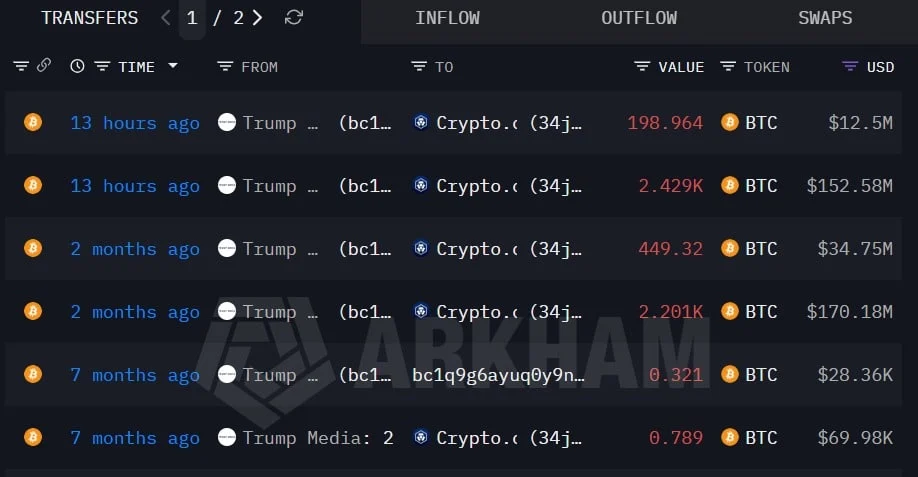
Source: Arkham
With losses mounting, Trump Media has continued to reduce its Bitcoin exposure, incurring losses in the process. According to Lookonchain, Trump Media sold another 2,628 BTC worth $165.07 million.
In this sale, they incurred $145 million in losses. In 2026 so far, they’ve already sold 7,281 BTC worth $545 million at an average price of about $74,860.
The yearly sales have locked in $318 million in losses. In total, the firm is currently sitting on losses of up to $555 million on BTC.
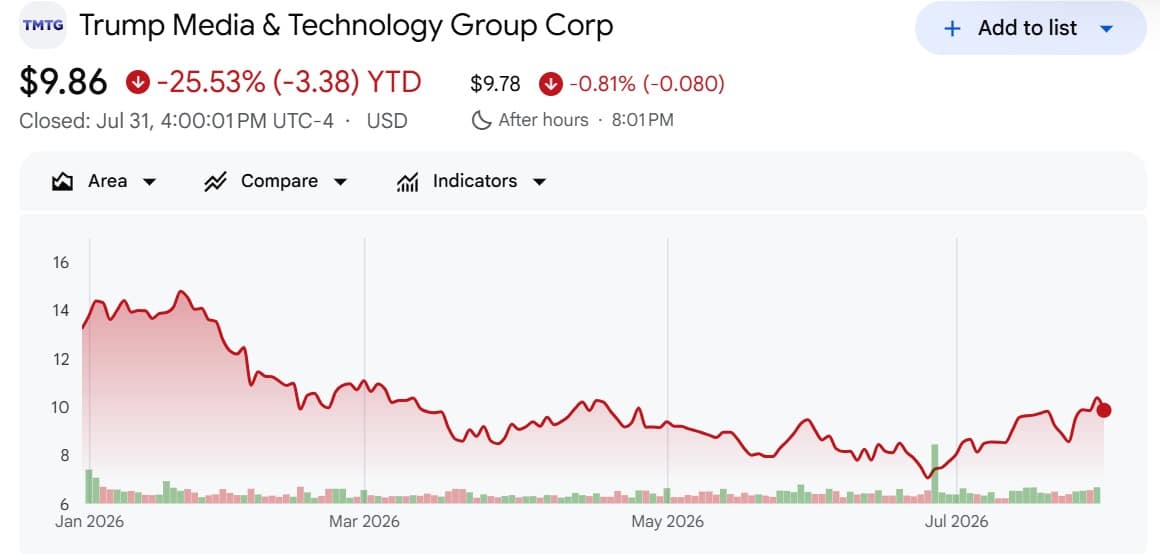
As Trump Media’s bet on Bitcoin crumbles, the company’s stock value has been hit hard. Although the shift into Bitcoin in 2025 did not spark a stock rally, the crypto’s continued decline has affected investor confidence.
Source: Google Finance
In fact, the Trump Media & Technology Group stock is already down 25% the past year and 25% YTD. This drop indicates the interconnection between the two.
Institutional investors are bearish amid rising losses
Trump Media Technology is not an isolated case, as many institutional investors flipped bearish and turned to selling.
For instance, AMBCrypto reported earlier that KULR Technology is on the verge of selling all its Bitcoin holdings. KULR Tech has sold 921 BTC, now holding only 100 BTC.
These companies that entered the market during the 2024 bull run have seen their BTC value drop by over $49 billion from their 2025 highs.
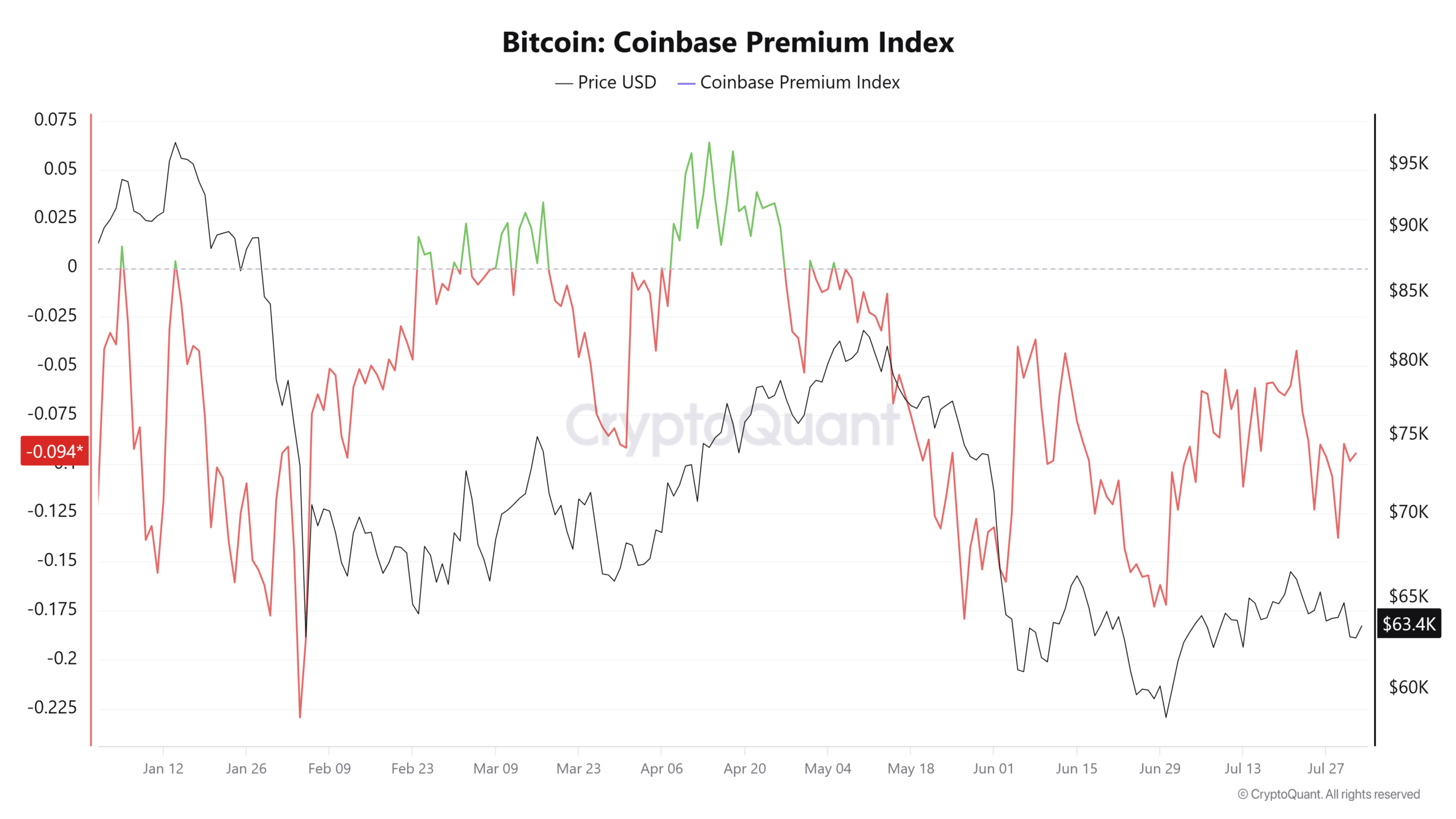
As a result, most of them have been aggressively selling in 2026. Looking at the Bitcoin’s Coinbase Premium Index, this metric has remained negative since May.
Source: CryptoQuant
In 2026, the Coinbase Premium Index has recorded a positive value for only 35 days. This suggests that Bitcoin has faced pressure from institutions for over five months.
Given the presence of large market players, Bitcoin has little chance of a price rebound. Since February 2024, institutions have significantly influenced market direction.
Therefore, if the current sentiment persists, the bearish market structure in Bitcoin will continue. A flip in institutional behavior holds the key to any market recovery.
Final Summary
Trump Media Technology offloaded 2,628 BTC worth $165.07 million, extending realized losses to $318 million.
Bitcoin seems positioned for an extended market structure.
That didn’t happen, and probably catalyzed the closure of those bets during Friday’s 08:00 UTC expiry, which settled BTC and ether (ETH) options worth $10 billion. Notional open interest on the $70,000 call has fallen to $943 million, and on the $72,000 call to $888 million. While still significant, those levels are well below the $60,000 put.
Another interesting data point comes from seasonality. Since 2013, July has produced a median return of 8.61%. The price has risen by 8.9% this month, according to CoinDesk data. So far, so unexciting. But a positive July is usually followed by a negative August, producing a median return of -7.51%.
Median is useful here because it shows the typical outcome without being skewed by unusually large gains or losses that can distort the average. In markets like bitcoin, where a few extreme months can pull the mean up or down, the median often gives a cleaner read on what has happened most often.
That means the mood is bearish for BTC as we head into August. Stay alert!
Read more: For analysis of today’s activity in altcoins and derivatives, see Crypto Markets Today . For a comprehensive list of events this week, see CoinDesk’s “Crypto Week Ahead.”
Find out how much you could earn by locking in a high CD rate today. A certificate of deposit (CD) allows you to lock in a competitive rate on your savings and helps your balance grow. However, rates vary widely across financial institutions, so it’s important to ensure you’re getting the best rate possible when shopping around for a CD. The following is a breakdown of CD rates today and where to find the best offers.
Overview of CD rates today
Historically, longer-term CDs offered higher interest rates than shorter-term CDs. Generally, this is because banks would pay better rates to encourage savers to keep their money on deposit longer. However, in today’s economic climate, the opposite is true.
Today, Sunday, August 2, 2026, the highest CD rate is 4.10%. This rate is offered by Marcus by Goldman Sachs on its 9-month CD.
How much interest can I earn with a CD?
The amount of interest you can earn from a CD depends on the annual percentage rate (APY). This is a measure of your total earnings after one year, taking into account the base interest rate and how often interest compounds (CD interest typically compounds daily or monthly).
Say you invest $1,000 in a one-year CD with 1.52% APY, and interest compounds monthly. At the end of that year, your balance would grow to $1,015.20 — your initial $1,000 deposit, plus $15.20 in interest.
Now let’s say you choose a one-year CD that offers 4% APY instead. In this case, your balance would grow to $1,040.74 over the same period, which includes $40.74 in interest.
The more you deposit in a CD, the more you stand to earn. If we used the same example of a one-year CD at 4% APY but deposited $10,000, your total balance when the CD matures would be $10,407.42, meaning you’d earn $407.42 in interest.
When choosing a CD, the interest rate is usually top of mind. However, the rate isn’t the only factor you should consider. There are several types of CDs that offer different benefits, though you may need to accept a slightly lower interest rate in exchange for more flexibility. Here’s a look at some of the common types of CDs you can consider beyond traditional CDs:
Bump-up CD: This type of CD allows you to request a higher interest rate if your bank’s rates go up during the account’s term. However, you’re usually allowed to “bump up” your rate just once.
No-penalty CD: Also known as a liquid CD, this type of CD allows you to withdraw funds before maturity without penalty.
Jumbo CD: These CDs require a higher minimum deposit (usually $100,000 or more), and often offer a higher interest rate in return. In today’s CD rate environment, however, the difference between traditional and jumbo CD rates may not be much.
Brokered CD: As the name suggests, these CDs are purchased through a brokerage rather than directly from a bank. Brokered CDs can sometimes offer higher rates or more flexible terms, but they also carry more risk and might not be FDIC-insured.
After posting a 7.36% ROI in July, Bitcoin [BTC] appears to be on track for a bullish August.
Backing this view, the Crypto Fear & Greed Index continues to hover in the “Fear” zone, a level that has historically marked strong accumulation opportunities. But the broader market is telling a different story. Instead of a clean bullish breakout, Bitcoin has started August caught in a classic FUD vs. FOMO battle, with FUD currently gaining the upper hand despite BTC continuing to hold key support.
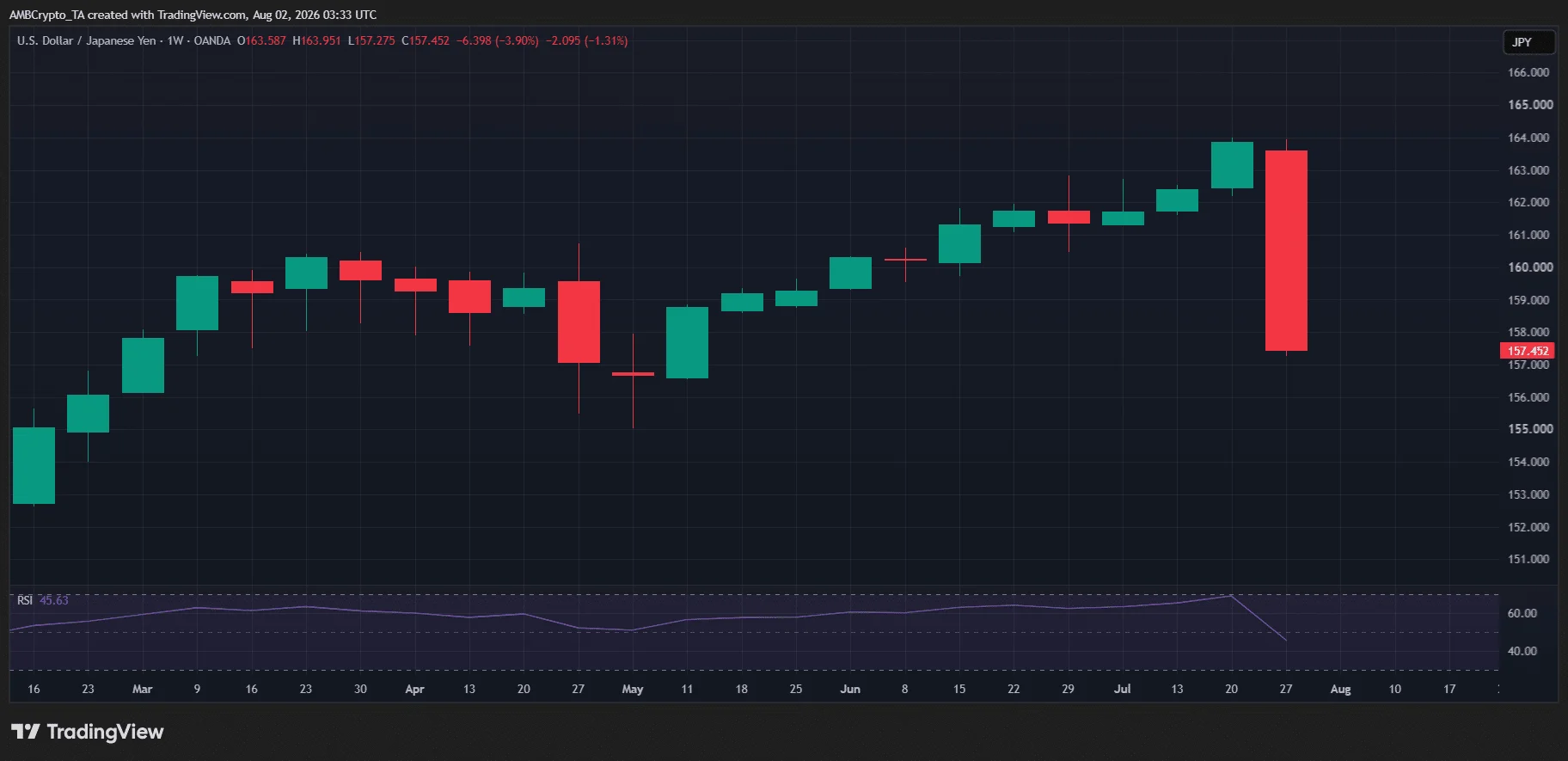
As the chart below shows, the USD/JPY pair is on track to close the week down more than 3%, dropping from 164 to 157 after Japan reportedly spent $52.8 billion defending the yen. The move was further fueled by the U.S. Treasury selling euros to buy yen, marking America’s first yen intervention since 1998. According to AMBCrypto, this macro shift could be setting the tone for Bitcoin’s August ROI.
Source: TradingView (USD/JPY)
Notably, the effects are already showing up across markets. The 30-year U.S. Treasury yield has climbed above 5.26%, its highest level since June 2007. Taken together, the falling USD/JPY pair and rising Treasury yields point to tightening liquidity conditions.
The logic is simple: Investors who borrowed cheap yen to buy risk assets are now unwinding those trades as the yen strengthens, while higher Treasury yields are pulling capital into safer investments. That leaves less money flowing into risk assets like Bitcoin, increasing the chances of downside pressure.
Against this backdrop, the market’s bearish call for BTC in August doesn’t look like a fluke. In fact, Kalshi traders are now betting on BTC breaking below $59k. With the yen carry trade unwind likely just the first wave of broader macro FUD, that downside scenario is starting to look a lot more credible.
Bitcoin’s bull trap fears grow as macro pressure intensifies
From another angle, a weaker U.S. dollar has historically been a tailwind for risk assets.
The logic is simple: a softer dollar encourages investors to move capital into risk assets like crypto. But this time, rising Treasury yields are changing the equation. As bond yields climb, investors can earn higher returns from lower-risk assets. Meanwhile, traders are now pricing in a roughly 60% chance of a rate hike at the September FOMC meeting, adding to expectations that financial conditions could tighten further.
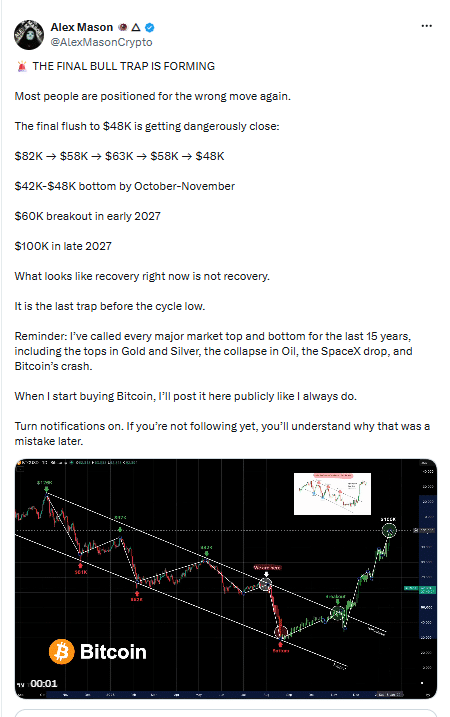
With that in mind, it’s easy to see why many traders are starting to view Bitcoin’s hold above $60k as a potential bull trap. As the analyst below noted, BTC’s “final flush” toward $48k may be getting closer. Add in weakening technicals and mounting macro FUD, and the case for a deeper correction is becoming increasingly hard to dismiss.
Source: X
That naturally puts Bitcoin’s August rally under increasing pressure.
With macro FUD building, rate hike expectations climbing, Treasury yields pushing to multi-year highs, and technicals losing momentum, Bitcoin’s $60k support is looking increasingly vulnerable. Unless those headwinds ease, a bearish August ROI is becoming a more realistic outcome.
At the time the platform’s website showed only a landing page, and CoinDesk could not verify whether it was operational or whether any cargo owners had used it. Fars claimed at the time the model could generate more than $10 billion without explaining how it arrived at that figure.
The policies were approved by the Persian Gulf Strait Authority, an IRGC-backed body Treasury designated in May. Both firms were sanctioned under an executive order covering Iran’s petroleum and petrochemical sectors.
Designation means U.S. persons are barred from dealing with the two companies, and foreign firms that transact with them risk sanctions themselves. Payments in bitcoin carry the same exposure as payments through banks.
“With its economy in freefall and inflation in the triple digits, the regime is desperate for cash,” Treasury Secretary Scott Bessent said in the statement.
The Strait of Hormuz is one of the world’s most important energy chokepoints, and traffic through it has thinned during weeks of U.S. strikes on Iran that have kept oil prices elevated.