Underlying economic pressures in the U.S. remain stickier than the consumer price index figure released Wednesday implies, according to macroeconomic writer Mike “Mish” Shedlock.
The CPI report showed inflation slowed in July amid a short retreat in energy prices.
In a blog post Wednesday, Shedlock noted that temporary drops in energy and gasoline prices make the headline figure look small. However, underneath, inflation remained sticky and food prices are undercounted by Bureau of Labor Statistics methods. He also argued that the index ignores key housing costs such as property taxes, insurance and home prices.
This could be why the marginal month‑on‑month increase and the year‑on‑year decline in CPI did not translate into a material softening of the Dollar Index, and therefore offered little support for bitcoin (BTC).
The cryptocurrency continues to trade choppy under $64,000.
American seniors pay dramatically more for brand-name prescription drugs than patients in 19 comparable countries, and the gap keeps widening each year.
AARP published a new report examining 25 top-selling brand-name drugs that account for more than $100 billion in annual Medicare spending.
The findings arrive at a critical moment, with a federal subsidy program ending after 2026 that currently holds down premiums for standalone Medicare drug plans.
Together, the pricing data and the subsidy expiration create financial pressure on roughly 25 million Americans enrolled in Medicare Part D coverage.
The report strengthens the case for drug price negotiation, a policy that began producing results in 2026 with the first ten Medicare-negotiated medications.
For retirees and those approaching Medicare eligibility, understanding both the pricing landscape and the coming premium changes will shape enrollment decisions this fall.
Brand-name drug prices rose 81% in the U.S. while falling abroad
U.S. prices for the 25 brand-name drugs in the study climbed 81% on average after their initial market launch, AARP’s press release showed. Prices for the same medications fell 13% on average across 19 comparable countries during the same period after launch.
Enbrel, a widely prescribed treatment for rheumatoid arthritis, showed the most extreme divergence in the study’s findings across markets.
Its U.S. price increased 873% after launch while falling 27% internationally, creating a gap that costs Medicare beneficiaries billions each year.
Januvia, a common diabetes medication, rose 126% domestically while declining 40% in the comparison countries included in the analysis.
Bill Sweeney, AARP’s senior vice president of government affairs, said seniors already struggle with healthcare expenses despite hard-won drug pricing reforms.
Older Americans are already stretched thin by rising health care costs. AARP fought hard to create Medicare Part D, to win Medicare the power to negotiate drug prices and to cap out-of-pocket costs for people in Part D
Medicare could save nearly $200 billion over five years on its ten highest-cost brand-name drugs by requiring manufacturers to match their lowest international prices, the full AARP report found.
The 25 drugs in the study collectively affected nearly 15 million Medicare beneficiaries, concentrating the cost burden on some of the program’s most common conditions.
A separate AARP report published in February found that retail prices for brand-name drugs widely used by older Americans have increased faster than inflation nearly every year since 2004, the organization’s Rx Price Watch series showed.
AARP researcher Leigh Purvis said Medicare drug price negotiation “is successfully reducing costs for millions of seniors” but called for expanding the program’s scope.
A federal subsidy expiration will push Part D premiums higher in 2027
The Centers for Medicare and Medicaid Services announced it will end the Part D Premium Stabilization Demonstration after 2026, removing a $9.8 billion support program.
That program had subsidized standalone prescription drug plans to keep monthly premiums lower than market rates would otherwise allow, NPR reported.
The 2027 national average monthly bid amount will rise to $296.05, a 24% increase that reflects both drug cost growth and the subsidy removal.
More Medicare/Medicaid:
Standalone drug plan enrollees currently pay about $36 per month on average and could lose roughly $16 in monthly subsidies, a KFF analysis found.
Vice President and Director of the Program on Medicare Policy at KFF Juliette Cubanski noted that losing $16 on a $36 premium represents “a large proportional change” for affected beneficiaries.
CMS administrator Mehmet Oz said premiums “will go up by less than $10 for most Medicare recipients,” framing the increase as manageable for the majority.
Medicare Advantage plans with built-in drug coverage charge roughly $8 per month on average, making the gap between plan types more visible after the subsidy ends, Forbes contributor Jesse Pines reported.
Medicare Part D premiums could rise in 2027 as a $9.8 billion subsidy expires, increasing costs for millions of prescription drug plan enrollees.Mirjana Pusicic / Getty Images
Negotiated prices and new protections offer partial relief
Medicare began paying negotiated prices on ten high-cost drugs in January 2026, including Eliquis, Jardiance, and Entresto, the Medicare Rights Center confirmed.
Another 15 medications are set to receive negotiated rates starting in 2027, expanding the program’s reach across additional therapeutic categories, eMedicare’s tracking list showed.
The Trump administration separately announced most-favored-nation agreements with 17 drugmakers, projecting $529 billion in savings over a decade.
Seniors with standalone Part D plans should use the October 15 through December 7 open enrollment period to weigh their existing coverage against Medicare Advantage options that bundle drug benefits at lower average premiums, according to AARP.
Whether those agreements and the expanding negotiation program can offset the premium increases from the subsidy expiration remains an open question heading into 2027.
How the 2027 premium changes will land for beneficiaries
CMS will publish final plan-specific premiums in mid-to-late September, giving enrollees roughly two months before open enrollment closes on December 7.
Standalone Part D holders paying $36 today could see that figure jump by $16 or more once the subsidy disappears, while Medicare Advantage drug coverage averages $8.
AARP has told beneficiaries to compare standalone plans against Medicare Advantage alternatives during open enrollment, noting that coverage networks, provider access, and formulary differences carry as much weight as the premium number in the final calculation.
The negotiated prices rolling out in 2027 will lower costs on 15 additional drugs, though which savings reach specific prescriptions depends on plan-level decisions beneficiaries make during open enrollment.
Market expectations and market rallies often move hand in hand.
Keeping this in mind, the latest U.S. CPI data should have ideally triggered a stronger rally, especially with crypto consolidating in a tight range for over 6-7 weeks now.
Yet, the reaction was pretty muted, with Bitcoin [BTC] up just 0.5% and still capped below the $65k resistance. This came after U.S. CPI printed a 3.4% for July, exactly in line with expectations.
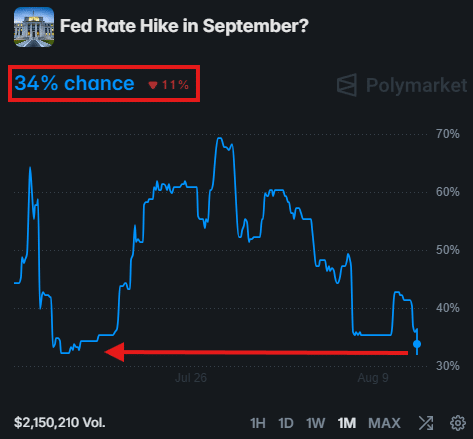
Further adding to the dovish expectations, market odds of a September rate hike fell to 34% after the U.S. CPI data was released.
This is the lowest probability of a September rate hike since the 17th of July, with odds now half of what they were on the 27th. In essence, rate hike expectations have cooled significantly.
Maksym Sakharov, co-founder and CEO of the debanking infrastructure provider WeFi, told AMBCrypto,
The softer print is welcome since the Fed will have more breathing room for deciding on a rate hike, but one release will not settle the argument over the inflation path due to pre-built volatility.
Source: Polymarket
However, these macro tailwinds might just be the tip of the iceberg.
Across social media, the narrative around a “Bitcoin bottom” and a potential “short squeeze” is heating up. From BTC’s technical setup, these narratives aren’t completely far-fetched either.
Echoing a similar narrative, Matt Mena, Senior Crypto Research Strategist at 21Shares, told AMBCrypto,
Bitcoin is testing support above $64k, retesting the level in the last few minutes after CPI came in line with expectations. With the odds of a September hike now down 25% MoM, this could be the relief Bitcoin needed to break $64k and push toward $66k.
Bitcoin continues to trade in a choppy range, with short liquidity building up and over $2.5 billion more shorts than longs. At the same time, on-chain signals are starting to point toward a stronger bottom setup.
So, for the market to rally, analysts expect Bitcoin may first need to flush short liquidity before gaining enough momentum for a breakout. Notably, this is where the lack of momentum after the U.S. CPI release begins to add weight.
The data came in line with expectations, but it still wasn’t enough to trigger the momentum needed for a breakout.
Naturally, this raises the question: Are the “bottom” and “short squeeze” narratives being overhyped, with the actual bottom still further away?
Bitcoin fails to rally on soft U.S. CPI as capitulation risk builds
The entire Bitcoin bottom thesis isn’t coming out of nowhere.
From an on-chain perspective, BTC has dropped into its “cost of production” zone, showing that BTC is trading closer to the level where miner profitability starts getting squeezed.
Historically, this zone has acted as a key trade of support and often signals that BTC is getting closer to a potential bottom. However, Kalshi traders are forecasting that BTC could close the month below $60k.
With ETF flows dominated by outflows, this further highlights the lack of buying momentum in the market despite the U.S. CPI release.
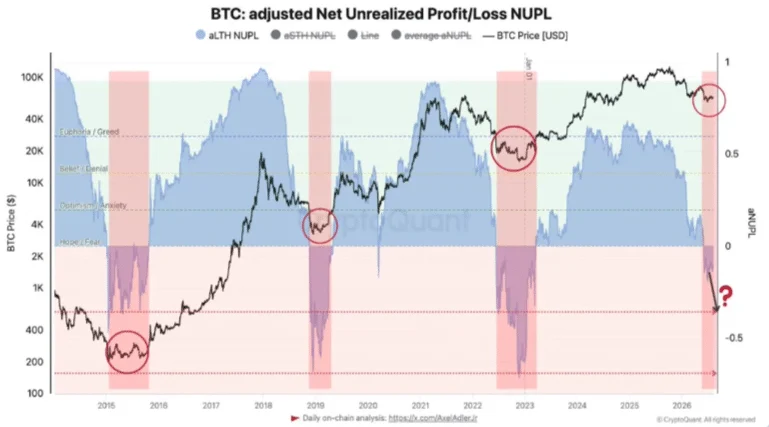
Notably, the stakes are getting higher as long-term holders’ unrealized losses continue to pile up. As the chart below highlights, BTC LTHs are now carrying deeper unrealized losses than the broader market. However, capitulation still hasn’t arrived.
Source: CryptoQuant
According to AMBCrypto, this puts the entire BTC bottom narrative under scrutiny.
With accumulation signals still lacking, ETF outflows picking up, and BTC failing to rally after the U.S. CPI release, the market is starting to question the entire Bitcoin bottom thesis.
This is putting even more pressure on BTC’s LTH cohort. As their patience wears thin, capitulation could kick in sooner than expected.
This, in turn, supports Kalshi’s bearish outlook, with traders expecting BTC to close the month below $60k.
Company CEO Simon Gerovich moved quickly to dismiss reports of a massive sale, clarifying that Wednesday’s large BTC transfer, flagged by blockchain trackers, was merely a “routine custody transfer” and not a liquidation.
“We transferred 5,014 BTC between Metaplanet custodial addresses over the past 24 hours. This was a routine custody operation. No bitcoin was sold, and our holdings remain 43,000 BTC,” Gerovich said.
On Wednesday, data tracking firms flagged the movement of 5,014 BTC, worth $320 million at the going spot price, from wallets linked to the firm. That sparked a speculation that the firm was preparing to sell those coins.
These so-called digital asset treasury firms, led by industry giant Strategy, has come under the microscope recently as investors watch for any sign of these major corporate holders trimming their positions to lock in gains or manage balance sheet risk.
Strategy has been selling portions of its BTC holdings to fund dividends on its preferred stock, repurchase STRC preferred shares and replenish its U.S. dollar reserve.
On August 3, 2026, President Trump accused ExxonMobil Holdings Corporation (NYSE:XOM) and Chevron Corporation (NYSE:CVX) of making “too much money” off high fuel prices just three days after both companies reported blowout second-quarter earnings fueled by the ongoing Iran war.
Trump told reporters, “Chevron, too much money. ExxonMobil, too much. Too much money,” demanding the companies “give some of that back to the public.”
Why Record Profits Just Became a Political Problem
Chevron Corporation (NYSE:CVX)’s earnings soared nearly 400% to $12 billion, and ExxonMobil Holdings Corporation (NYSE:XOM)’s more than doubled to $14.5 billion, both driven by crude prices that jumped after the U.S. and Israel struck Iran in February and Tehran retaliated by threatening the Strait of Hormuz. Gasoline prices have climbed nearly 40% since the war began, a real problem for Trump heading into November’s midterm elections.
Earlier Monday, Trump also publicly criticized Chevron CEO Mike Wirth on social media for not crediting his administration during a Fox News interview, writing that without “the genius, foresight, strength, and stability” of his administration, the oil industry “would be DEAD.”
This makes you wonder: Is Trump’s political pressure a real threat to these huge oil profits, or just pre-election talk while prices are already sliding on hope the Iran conflict ends soon?
ExxonMobil Holdings Corporation (XOM) vs. Chevron Corporation (CVX): Trump Attacks the Oil Giants for Making “Too Much Money”
For illustration purposes only. Photo by Kayden Moore on Pexels
Chevron’s Bull and Bear Case
Chevron Corporation (NYSE:CVX)’s quarterly profit was its highest in at least six years, and the company’s return to Venezuela stands out as a genuine growth story: it stayed in the country through nationalization in 2007 while Exxon and ConocoPhillips both exited, and Trump himself noted Chevron is “back, far bigger and stronger than ever before.”
However, Chevron shares fell about 2% after Trump’s comments Monday, and the company now faces direct presidential pressure to cut prices even as it posts record results. Being singled out by name is a real reputational risk few oil executives want.
Exxon’s Bull and Bear Case
ExxonMobil Holdings Corporation (NYSE:XOM)’s profit more than doubled year over year, showing just how much the Iran-driven price spike has boosted the industry’s biggest player. The company still makes huge amounts of cash, even without a big comeback story like Chevron’s.
Still, Exxon shares also slipped after Trump’s remarks. Unlike Chevron, Exxon left Venezuela in 2007, leaving it with fewer growth options besides high oil prices, which just dropped 5% on Monday as Iran tensions eased.
Insider Monkey’s Hedge Fund Data
Insider Monkey’s hedge fund database shows Chevron had 103 hedge fund holders as of Q1 2026, up from 86 the quarter before, with the dollar value hedge funds held rising from about $26.3 billion to $29.6 billion. ExxonMobil Holdings Corporation (NYSE:XOM) had 94 holders, down from 98.
Among refining peers, Valero had 67 holders, up from 65, and Marathon Petroleum had 54, down from 64. Chevron draws more hedge fund interest than Exxon and both refiners.
Conclusion
Both companies just posted some of their best results in years, but the same war that delivered those profits has now put a target on their backs in Washington. Neither company controls how long that political pressure or the high oil prices behind it will last.
Overall, Chevron Corporation (NYSE:CVX) wins since it draws more hedge fund interest than Exxon.
While we acknowledge the potential of CVX as an investment, we believe certain AI stocks offer greater upside potential and carry less downside risk. If you’re looking for an extremely undervalued AI stock that also stands to benefit significantly from Trump-era tariffs and the onshoring trend, see our free report on thebest short-term AI stock.
More than three dozen bitcoin and crypto companies have asked the largest AI labs to give open-source security researchers early access to their most capable models, arguing that the people defending a trillion dollars of infrastructure are working with weaker tools than the people attacking it.
The letter, organised by the Bitcoin Policy Institute and published earlier this week is signed by Coinbase, Block, BitGo, Blockstream, Anchorage Digital, ARK Invest, Bitwise, Foundry, Casa, Exodus and others, alongside nonprofit developer funds including Brink, Chaincode and Btrust.
Its central complaint is specific that Bitcoin Core developers, the small group maintaining the software that runs the network, cannot get into the programs labs run for trusted security partners.
When they turn to publicly available models instead, the safety filters designed to stop people writing malware also block the work of finding flaws before criminals do.
That leaves them on open-weight models, which are freely downloadable and generally less capable.
Attackers face none of those constraints. The letter said the labs and a handful of partners can see new offensive capabilities months before anyone else, while those capabilities spread anyway through public models, stolen access to corporate systems and purpose-built hacking tools.
Xtant Medical Holdings, Inc. Q2 2026 Earnings Call Summary – Moby
Strategic Performance Drivers
Our analysts just identified a stock with the potential to be the next Nvidia. Tell us how you invest and we’ll show you why it’s our #1 pick. Tap here.
Reported revenue faced significant year-over-year headwinds due to the divestiture of non-core assets to Companion Spine and the cessation of certain license revenue following reimbursement changes.
The integration of 17 new sales representatives from the Dilon distribution agreement consumed significant management resources, contributing to softer-than-expected Q2 sales performance.
Management attributed biologics underperformance to softness in legacy ‘workhorse’ product lines and ongoing headwinds in the amniotic membrane market tied to advanced wound care.
The launch of Trivium Shaped in May is driving early sales momentum by addressing surgeon needs for pre-shaped configurations that reduce preparation time and improve consistency.
The company is transitioning from a small commercial footprint to a scaled organization with over 25 reps and expanded national accounts teams to drive institutional adoption.
Strategic entry into the $1 billion hemostasis market via HEMOBLAST Bellows provides access to high-value hospital systems like Cleveland Clinic and Mass General.
Outlook and Strategic Assumptions
Full-year 2026 revenue guidance was modestly reduced to $99 million to $103 million, reflecting Q2 biologics softness and persistent amnio product headwinds.
Management expects accelerating biologics growth in Q3 and beyond as the newly integrated specialty reps move past the learning curve and begin selling the full product bag.
Substantially all HEMOBLAST Bellows sales are expected to transition to Xtant’s own customer agreements, allowing for gross revenue recognition versus the net basis used in Q2.
The company anticipates significant sales synergies as legacy reps and new specialty reps share few overlapping call points, allowing for broader market penetration.
Future growth strategy relies on leveraging a broad regenerative medicine portfolio to become a ‘one-stop shop’ for hospital materials management and large practice groups.
Operational and Financial Context
A $5 million exclusivity fee paid to Dilon Technologies was recorded as a one-time operating expense in the second quarter.
Gross margin declined to 57.9% primarily due to the termination of Q-Code license revenue and reduced production efficiencies.
Revenue recognition for HEMOBLAST was approximately $600,000 to $700,000 lower than potential due to the timing of transitioning purchase orders from Dilon to Xtant.
Cash and cash equivalents decreased to $9.9 million as of June 30, 2026, compared to $17.3 million at the end of 2025.
Q&A Session Highlights
One stock. Nvidia-level potential. 30M+ investors trust Moby to find it first. Get the pick. Tap here.
Specific drivers of orthobiologics underperformance relative to initial expectations
Management identified ‘old line’ products like OsteoSelect and OsteoSponge as being down more than anticipated.
The Amnio product line remains soft, and while ‘green shoots’ were expected, the recovery has not yet materialized as planned.
Cross-selling opportunities and synergies from the Dilon sales force
The new reps provide entry into non-orthobiologic areas like OB/GYN where products like CollagenX and Amnio have strong applications.
The 17 new reps will be tasked with managing approximately 400 ‘transactional’ independent agent accounts that previously lacked consistent coverage.
Management believes the new team’s relationships with hospital materials management will facilitate larger institutional contracts.
HEMOBLAST revenue recognition and transactional volume expectations
Management maintains an expectation of over $1 million per month in gross transactional volume for HEMOBLAST.
A ‘buffer’ remains in Q3 guidance to account for any remaining orders that might still be processed through Dilon during the final stages of the contract transition.